
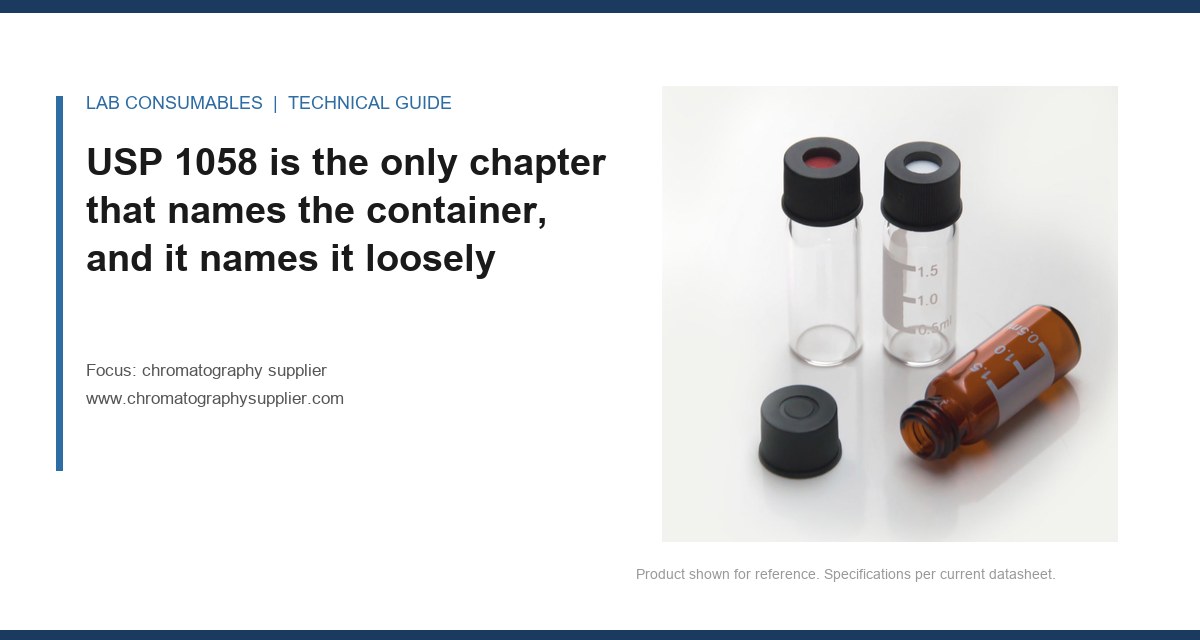
A 6-point system suitability run failed on peak area RSD at 2.8% against a 2.0% limit, and the analyst had already repeated the injection twice before anyone looked at the vial. The lot number on the crimp cap traced to a closure lot that had been requalified under the lab’s own internal specification, not under any USP chapter. That gap is the whole subject of this article: which USP requirements for a chromatography supplier in a validated method actually reach the consumable, and which ones stop at the instrument, the column, or the analyst’s hands.
USP <1058> is the only chapter that names the container, and it names it loosely
If you go looking for a USP chapter that tells a chromatography supplier what a crimp seal must do, you will find exactly one: USP <1058> “Suitability of Plastic Materials and Containers for Packaging, Storage, and Transport of Pharmaceutical Products”. It is a packaging chapter, not an analytical chemistry chapter. It addresses extractables, leachables, and the biological reactivity of the material in contact with the product. It does not specify a septum durometer, a cap crimp dimension, or a puncture count.
What <1058> does give you is a framework you can borrow. The chapter distinguishes between the material of construction and the finished container, and it requires that suitability be demonstrated for the intended use. For a supplier of septa and closures, that means the material declaration (what polymer, what filler, what lubricant) is the supplier’s obligation, and the demonstration that the finished closure suits the method is yours. That division of labor is the single most useful thing to take from the chapter.
In practice, I treat <1058> as a floor. It tells me the supplier must be able to state the composition of a silicone septum, a PTFE-faced liner, or a butyl stopper and support that statement with a material certificate. It does not tell me the septum will survive 40 autosampler injections without coring. That number comes from somewhere else, and I will get to it.
USP <621> governs the chromatogram, not the vial, and that is the point
USP <621> Chromatography is where most people expect the answer to live. It defines system suitability: tailing factor, resolution, theoretical plates, and repeatability. It sets the framework that the analytical procedure must meet before results are reportable. Read it carefully and you will notice it never mentions a consumable. It describes the output of the system, and the system is whatever you assembled.
This is where suppliers get sloppy in their marketing. A supplier will claim a septum is “USP compliant.” There is no such designation for a septum. What <621> gives you is a set of performance criteria that your method validation has to satisfy, and the consumable either contributes to meeting them or it does not. A vial with a poorly seated septum that admits air during a headspace run will wreck repeatability, and <621> will flag it as a system suitability failure without ever mentioning the vial.
So the practical reading is inverted. <621> does not constrain the supplier. It constrains you. The supplier’s job is to deliver dimensional consistency tight enough that the <621> criteria are reproducible from lot to lot. When I qualify a closure lot, I am not checking compliance with <621>. I am checking that the lot does not move the <621> numbers outside the limits my method already established.
USP <788> and <1788> reach the consumable through particle burden
For methods that involve particulate or subvisible analysis, USP <788> “Particulate Matter in Injections” and its informational companion <1788> do reach the consumable, indirectly but concretely. A septum that sheds silicone particles into the sample path adds to the particle count. A vial that was not rinsed after manufacturing carries residue that shows up as light obscuration events.
I have seen this bite. A light obscuration method on a small-volume injection was running 18 particles ≥10 µm per container above the historical baseline. The instrument was clean, the diluent was fresh, and the method had not changed. The closure lot had changed. The new lot used a silicone oil lubricant on the stopper that the previous lot did not. The fix was to specify a lubricant-free or a low-shedding closure in the lab’s own specification and to add a particle-count screen to the incoming lot qualification. <788> did not tell me to do that. It told me the result was out of specification, and the investigation led to the closure.
This is the pattern with every USP chapter that touches the consumable. The chapter defines the result. The consumable is one of many inputs to that result. Your specification is what controls the input.
What the general chapters require of the supplier versus what they leave to your specification
Here is the split, laid out plainly. The left column is what a USP chapter obliges the supplier to be able to state or support. The right column is what no chapter will do for you, and what you must write into your own incoming specification and method validation.
| Requirement | USP chapter that reaches it | What the supplier owes you | What your specification must add |
|---|---|---|---|
| Material composition of septum and liner | <1058> | Material declaration, certificate of analysis, extractables data on request | Acceptable polymer grade, filler type, lubricant presence or absence |
| Biological reactivity of elastomer | <87>, <88> (via <1058>) | Test data on the elastomer family | Whether the method requires it at all; most do not |
| System suitability contribution | <621> | Lot-to-lot dimensional consistency | Tailing factor, resolution, and RSD limits your method already validated |
| Particle burden | <788>, <1788> | Cleanliness data, manufacturing rinse protocol | Particle-count screen per lot, acceptance number, test method |
| Dimensional fit | None | Dimensional drawing with tolerances | Crimp diameter, cap height, septum thickness, GPI thread spec |
| Puncture performance | None | Nominal puncture count | Minimum puncture count for your injection sequence, coring test method |
| Thermal limits | None | Continuous service temperature range | Maximum oven or autoclave temperature your method uses, with margin |
| Seal integrity after crimping | None | Crimp recommendation | Crimp torque or crimp height target, leak test, acceptance criteria |
Notice how many rows have “None” in the chapter column. That is the honest answer. The dimensional and mechanical requirements that determine whether a closure works in your method are not in any USP chapter. They are in the supplier’s drawing and in your specification. If you are relying on USP to qualify a closure, you are relying on the wrong document.
The dimensional specification is yours to write, and it has numbers in it
Because no chapter gives you the numbers, you have to set them. Here is what I put in a closure specification for a standard 2 mL crimp vial, and where each number comes from.
- Crimp diameter: 11.0 mm nominal, ±0.2 mm for an 11 mm crimp finish. Measure with a crimp gauge, not calipers, on every lot. A crimp that runs large leaks under headspace pressure; one that runs small cracks the vial neck.
- Seal height after crimping: 6.0 to 6.4 mm for a standard 11 mm aluminum seal on a 32 x 11.6 mm vial. This is the number that catches a worn crimper jaw before it catches your method.
- Septum thickness: 1.0 mm nominal, ±0.05 mm for a 11 mm silicone/PTFE septum. Thinner and you core; thicker and the needle does not fully penetrate on a short-stroke autosampler.
- PTFE facing thickness: 0.13 mm minimum. This is the barrier that keeps the sample off the silicone. Below that, the facing can be punched through on the first injection and the silicone is exposed for the rest of the run.
- Thread finish: GPI 8-425 or GPI 13-425 depending on the vial, with the thread pitch and root diameter on the drawing. Do not accept “fits standard vials” as a specification. Ask for the thread callout.
These are the numbers that determine whether a lot works. They are also the numbers a good supplier will already have on a drawing and will send you without argument. If a supplier cannot produce a dimensional drawing with tolerances on request, that is a qualification failure in itself. I have walked away from suppliers over exactly that.
Two field cases where the chapter did not catch the problem
Case one: the headspace leak that looked like a method drift
A residual solvent method by headspace GC started failing resolution between two early-eluting peaks. The analyst revalidated the column, then the method, then the instrument. Nothing moved. The resolution was 1.3 against a limit of 1.5, and it had been 1.9 two months earlier.
The measurement that identified it was a simple leak check: pressurize a sealed vial to 1.5 bar and hold for 60 seconds, watch for pressure decay. Three of ten vials from the current lot decayed more than 0.1 bar. The previous lot held. The cause was a change in the aluminum seal temper. The softer alloy deformed more under the same crimp force, and the seal lost its spring-back. The crimp height was in spec, but the seal was not sealing.
The fix was twofold. First, the specification now includes a seal temper callout and a 60-second pressure hold test on a sample of every lot. Second, the crimper was recalibrated to a crimp height of 6.2 mm rather than the 6.0 mm the operator had drifted to. The resolution returned to 1.8 and held. No USP chapter flagged the seal temper. The system suitability test flagged the symptom, and the leak test found the cause.
Case two: the coring that passed system suitability
A method with a 96-injection autosampler sequence passed system suitability on the first six injections and failed at injection 70. The failure was a sudden drop in peak area for the analyte, consistent with a partial needle blockage. The analyst assumed a sample problem. The actual problem was coring: the septum had been punched through and a plug of silicone had lodged in the needle.
The measurement was a puncture test on the same lot: 50 punctures with a 23-gauge needle at the same point, then inspection of the septum under 10x magnification. The lot showed visible coring at puncture 38. The supplier’s nominal claim was 100 punctures. The difference was the needle gauge. The supplier had qualified at 22 gauge; the method used 23 gauge, which is a smaller needle and cores more aggressively because the punch load is concentrated over a smaller area.
The fix was to specify puncture count at the actual needle gauge used in the method, and to add a 50-puncture coring screen to lot qualification. The supplier re-qualified at 23 gauge and the new lot held to 80 punctures without visible coring. That number is now in the specification. It is not in any USP chapter, and it never will be.
A lot qualification checklist you can run against any supplier
This is the checklist I use when qualifying a closure lot for a validated method. It is built to catch the things the USP chapters do not.
- Dimensional audit: crimp diameter, seal height, septum thickness, PTFE facing thickness, thread callout. Sample size n=30 per lot, measured with a crimp gauge and a micrometer, not calipers.
- Crimp and leak test: seal 10 vials, pressurize to 1.5 bar, hold 60 seconds, accept if pressure decay is below 0.1 bar on all ten.
- Puncture and coring screen: 50 punctures at the method’s needle gauge, inspect at 10x, reject visible coring.
- System suitability run: full 6-injection suitability run, check tailing factor, resolution, and area RSD against the validated limits.
- Particle screen (if the method is particle-sensitive): light obscuration count, compare against the historical baseline for the method.
- Material certificate: polymer grade, filler, lubricant presence, and a statement of no change since the last qualified lot. A supplier that cannot state “no change” is a supplier you cannot trend.
- Retain sample: hold one full box from every lot for the life of the method, so a future failure can be traced to a lot rather than to a memory.
Run this checklist once per lot for the first three lots from a new supplier, then reduce to the dimensional audit and the system suitability run once the supplier has demonstrated consistency. That is the point at which you can start trusting the supplier’s certificate. Not before.
Where to source and how to write the specification so it survives an inspection
The specification is the document that carries the weight. Write it so that a reviewer can see, line by line, which requirement came from a USP chapter and which came from your own validation. That separation is what makes the specification defensible. When an inspector asks why the septum has a 1.0 mm thickness tolerance and not 1.2 mm, the answer is that 1.2 mm failed the puncture screen at 38 punctures. That is a validation finding, and it is a better answer than a citation to a chapter that does not exist.
For sourcing, work with a supplier who will accept your specification rather than hand you theirs. A supplier who publishes dimensional drawings with tolerances and supports them with lot data is a supplier you can build a specification around. The Chromatography Supplier catalog is a starting point for the closure families, but the specification is the thing that makes the relationship work. For vials and closures specifically, the OEM vial and vial closures ranges are where the dimensional callouts live, and you should be able to get the thread callout (GPI 8-425 or GPI 13-425) and the septum thickness tolerance from the drawing before you commit to a lot.
For method development and lot qualification testing that you do not want to run in-house, an analytical testing lab can run the puncture, leak, and particle screens against your acceptance criteria. That is often cheaper than building the fixtures yourself, and it gives you an independent record for the method file.
For reference data on column and consumable performance that feeds into the same method, the technical resources from Agilent, Thermo Fisher, and Restek are useful for understanding what the column and liner contribute to the same system suitability numbers. The EPA SW-846 methods are a separate compliance track and are not the subject here, but they share the same consumable qualification logic.
The decision rule
Treat the USP chapters as the boundary of what the supplier owes you and nothing more. <1058> gets you a material declaration. <621> gets you a system suitability framework that the consumable must not break. <788> and <1788> get you a particle result that the consumable can quietly ruin. Everything that determines whether a closure actually works in your validated method, the crimp diameter, the seal height, the septum thickness, the puncture count at your needle gauge, the leak test, the particle screen, is yours to specify. Write those numbers into your incoming specification, qualify every lot against them, and keep a retain sample. The chapter will not do it for you, and a supplier who claims it will is telling you something about how they handle specifications.
References & further reading
Related resources from our lab consumables network:
- Chromatography Supplier at chromatographysupplier.com
- Oem Vial at oemsamplevials.com
- Vial Closures at vialclosures.com
- Analytical Testing at labanalyticaltesting.com
External references and standards: