
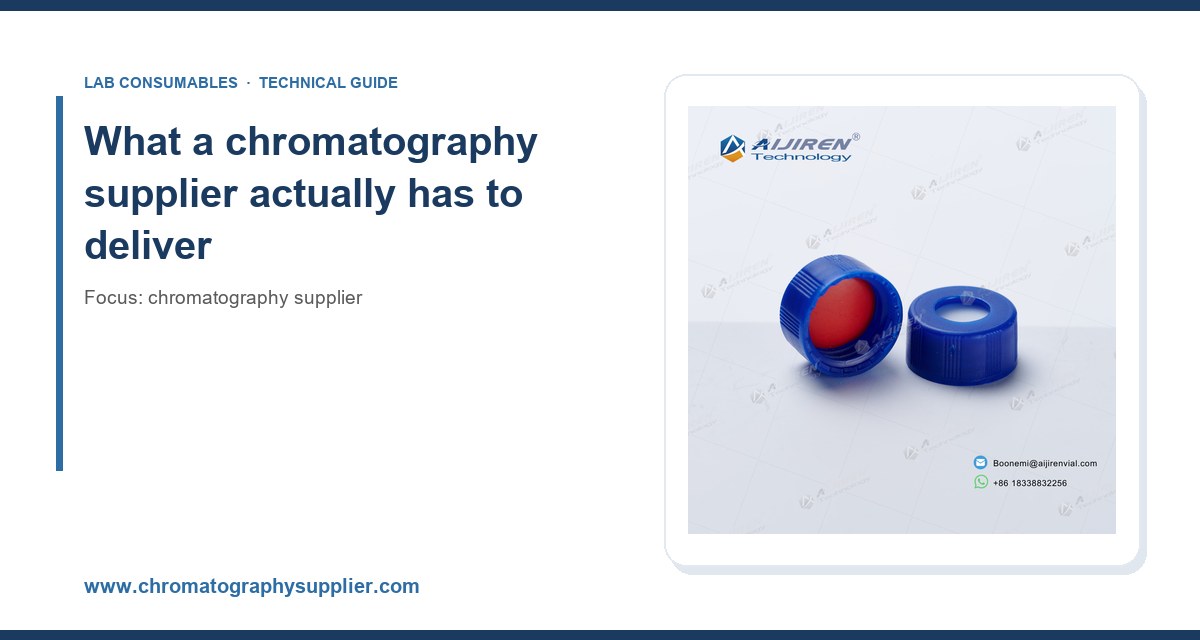
I have bought chromatography consumables from four different suppliers in the last decade, and the one that hurt me most was not the cheapest or the slowest. It was the one that shipped a case of 2 mL vials with a septum lot that coring-shed silicone into my autosampler after 40 injections, then argued that the problem was my needle. That week cost me three validated runs and a client call I would rather forget. Supplier selection in chromatography is not a price-per-box exercise. It is a risk management decision about whether your injections will still be clean on the 300th puncture and whether the column you ordered in March will have the same lot number behavior in September.
This guide is what I wish someone had handed me on day one. It covers how to evaluate a supplier across the things that actually break workflows: column reproducibility, vial and closure geometry, septa chemistry, delivery reliability, documentation, and after-sale technical competence. I will give you numbers where numbers matter, and a decision checklist you can run against any supplier before you sign a blanket purchase order.
Break the supply chain into five buckets and evaluate each one separately. Most buyers collapse them into a single “price and lead time” comparison, which is why they get burned on one bucket and never notice until a method fails system suitability.
- Columns and consumables for separation: analytical columns, guard cartridges, liners, ferrules, septa, and the fittings that connect them.
- Sample handling hardware: vials, caps, septa, inserts, and the dimensional tolerances that decide whether your autosampler gripper can pick them up.
- Solvents and reagents at HPLC or LC-MS grade, with certificates of analysis that actually match the lot.
- Documentation: CoA, CoC, material certifications, and method-transfer support.
- Service: technical answers within a working day, replacement policy, and the willingness to admit when a lot is bad.
A supplier that is strong on columns and weak on vials is a supplier that will cost you a re-run a month. You need a primary vendor that is competent across at least the first four buckets, or a deliberate split between a column specialist and a consumables specialist with clear ownership of each failure mode.
Columns first: what reproducibility really means
Column lot-to-lot reproducibility is the single most expensive variable in a regulated lab. When you validate a method on a C18 column and the next lot gives you a 0.4-minute shift in retention time, you spend a day re-equilibrating and a week explaining it in the change control. Ask every candidate supplier three questions before you buy:
1. What is the manufacturing batch size and how is it tested?
A supplier that tests every batch against a retained reference standard and publishes a batch certificate is doing the minimum. Ask for the actual test chromatogram and the acceptance criteria. A reputable manufacturer will show you retention time RSD across the batch below 1.0% and tailing factor between 0.9 and 1.1 for a neutral probe. If they cannot produce that on request, they are a reseller, not a manufacturer.
2. What is the particle size distribution and pore geometry?
For a 5 µm column, the useful specification is a D90 within about 4.5 to 5.5 µm and a pore diameter of 100 to 120 Å for small molecules. Wider distributions cost you efficiency and pressure reproducibility. For UHPLC work at 1.7 to 1.8 µm, ask about the pressure rating: 1000 bar (15,000 psi) is now table stakes; anything rated below 600 bar is a compromise you will feel on a modern instrument.
3. What is the pH and temperature envelope?
Standard silica C18 is comfortable at pH 2 to 8. If your method runs at pH 10, you need a hybrid or bridged-ethylene-hybrid particle, and you need the supplier to state the hydrolysis resistance in hours at temperature. A column rated to 60 °C that you run at 65 °C will lose retention in a few hundred injections. I have seen this on amine methods more than once.
For reference specifications, the technical libraries at Agilent’s chromatography consumables and columns page and Restek’s technical resources are the two I keep open when I am comparing phase chemistries. Both publish the kind of retention and stability data you can use to sanity-check a supplier’s claims.
Vials and closures: where cheap suppliers quietly fail
This is the part of the buying decision most procurement teams underweight, and it is where the money goes. A 2 mL autosampler vial looks trivial until the dimensions are off by 0.3 mm and your gripper drops it into the tray.
Dimensional tolerances that matter
The working numbers for a standard 12 x 32 mm vial are:
- Body diameter: 12.0 mm ± 0.2 mm. Anything outside this and the tray position drifts.
- Height: 32.0 mm ± 0.3 mm. Too tall and the needle bottoms out; too short and the needle misses the sample.
- Neck finish: 8-425 for screw-thread vials, 11 mm for crimp and snap-top, and 13-425 for the larger screw vials. Get the thread wrong and the cap will cross-thread on the first turn.
- Insert volume: 150 µL or 250 µL glass inserts, with a bottom taper that leaves less than 5 µL dead volume.
If you are buying vials for a specific instrument platform, buy from a supplier that publishes the tolerance drawing. For OEM-grade vials that match instrument manufacturer dimensions, the catalog at OEM sample vials is worth a look because they publish the dimensional spec rather than just the nominal size.
Septa: the failure mode nobody budgets for
The septum is the part that actually touches your sample. The three chemistries you will choose between are:
- Silicone: excellent reseal, poor solvent resistance, high bleed. Good for aqueous samples, bad for GC-MS.
- PTFE-faced silicone: the workhorse. PTFE face protects the sample from the silicone, silicone provides the reseal. Rated for 100 to 200 punctures in typical autosampler use, but I plan on 50 to 100 before I change them on a busy instrument.
- Butyl or buna-N: low bleed, poor reseal after multiple punctures. Use for headspace or short-run work.
The coring problem I opened with is a durometer and needle-gauge issue. A septum below about 45 Shore A will coring-shed with a 23-gauge needle at high injection frequency. Ask the supplier for the durometer and the recommended needle gauge. If they cannot answer, they do not make the septum. The closure catalog at vial closures lists durometer and temperature ratings per septum type, which is the level of detail you want from any supplier you keep.
Caps and torque
Screw caps need consistent torque or you get evaporation and septum push-through. The working range for an 8-425 screw cap is 0.8 to 1.2 N·m. Below that, the seal leaks over a 24-hour run; above it, the cap cracks at the thread root. If your lab hand-tightens, you are somewhere between 0.5 and 2.0 N·m depending on the analyst. Buy a torque wrench or buy pre-assembled caps. Suppliers that sell pre-assembled vial-and-cap combinations with a stated torque are worth the small premium.
Solvents, reagents, and the CoA question
HPLC-grade acetonitrile and methanol are commodities until they are not. The difference between a good lot and a bad lot shows up as a rising baseline at 210 nm, ghost peaks in gradient runs, or a UV cutoff that fails your method’s detection limit. Ask for:
- UV cutoff at the wavelength you run. Acetonitrile should be below 190 nm; methanol below 205 nm.
- Water content below 0.02% for gradient work.
- Residue after evaporation below 1 ppm for LC-MS grade.
- A CoA that carries the lot number printed on the bottle. I have received cases where the CoA was for a different lot, and the supplier’s response was “they are all the same.” They are not.
If you outsource method development or verification, the analytical partner you use should be able to run a lot-release check on incoming solvent. The services at analytical testing cover incoming-material verification and method transfer, which is cheaper than discovering a bad solvent lot mid-validation.
Delivery reliability and inventory strategy
A supplier with a great catalog and a two-week lead time on septa is a supplier that will stop your autosampler. Track these metrics for any candidate over a 90-day trial:
- On-time delivery rate: target above 95% for catalog items.
- Backorder frequency on the ten SKUs you order most. If any of your top ten goes on backorder in the trial, that is a warning.
- Lot consolidation: can they hold a single lot of vials and septa for you across a quarter? For validated methods, lot consistency matters more than price.
- Emergency fulfillment: what is the cutoff time for next-day shipment, and what does it cost?
My rule is to hold two months of consumable inventory for anything on the critical path, and to dual-source the top five SKUs. Dual-sourcing costs about 5 to 10% more on paper and saves you a shutdown. The primary supplier gets 70% of volume, the secondary gets 30% and the right of first refusal on emergencies.
Documentation and regulatory fit
If you work under GMP, ISO 17025, or EPA methods, the supplier’s paperwork is part of your quality system. Minimum requirements:
- Certificate of analysis per lot, with the test methods named.
- Certificate of conformance for hardware, with material grades (for example, 316L stainless steel for wetted fittings, PEEK for biocompatible flow paths).
- Material safety data sheets in the language of the destination country.
- Change notification: a contractual clause requiring notice before a manufacturing change that could affect performance. This is the clause most buyers forget, and it is the one that saves your validation.
For environmental work, confirm the supplier’s consumables are compatible with the methods you run under U.S. EPA SW-846 test methods. Method 8260 for volatile organics, for example, has specific requirements for purge-and-trap and headspace consumables that a generalist supplier will not know. Ask them to name the method and the consumable that supports it. If they cannot, they are not your environmental supplier.
Technical support: the test that separates suppliers
Here is the test I run on every new supplier before I place a real order. I call the technical line and ask a specific question: “What is the maximum temperature for your 11 mm PTFE-faced silicone septum, and what is the recommended needle gauge?” A competent supplier answers in under five minutes with a number and a reason. A reseller transfers me twice and then reads the catalog back to me.
Do this three times with three different questions before you commit. The questions should be ones you already know the answer to. You are testing the response, not the answer. A supplier that says “I do not know, let me find out and call you back within the hour” and then does is worth more than one that bluffs.
For instrument-specific questions, the technical libraries at Thermo Fisher’s chromatography and sample handling resources are a useful cross-check. If your supplier’s answer contradicts the instrument manufacturer’s published spec, believe the instrument manufacturer and ask the supplier to explain the discrepancy.
Comparison checklist: scoring a supplier in 20 minutes
Use this table on any candidate. Score each row 1 to 5 and require a minimum of 60 out of 100 before you place a trial order. I have used this on six suppliers in five years and it has predicted every problem I later had.
- Column batch testing (retention RSD under 1.0%, tailing 0.9 to 1.1): 15 points
- Vial dimensional tolerance published (12.0 ± 0.2 mm, 32.0 ± 0.3 mm): 10 points
- Septa durometer and puncture rating stated (45 Shore A minimum, 50 to 200 punctures): 10 points
- Solvent CoA per lot with UV cutoff and water content: 10 points
- On-time delivery above 95% over 90 days: 10 points
- Technical phone answer within 5 minutes: 10 points
- Change notification clause accepted: 10 points
- Dual-source availability for top 5 SKUs: 10 points
- Price within 15% of lowest quote: 10 points
- Method-specific support (can name EPA, USP, or ISO method and matching consumable): 5 points
Notice that price is only 10 points. A supplier that scores 90 and is 12% more expensive than the lowest bidder is the better buy in almost every lab I have run. The lowest bidder wins on paper and loses on the third re-run of the month.
Troubleshooting checklist when a new supplier’s product misbehaves
When something goes wrong, work through this in order before you blame the method. I have solved about 80% of “bad supplier” complaints with the first four steps.
- Check the lot number against the CoA and against your previous lot. A change in lot is the most common cause of a shift.
- Run a system suitability standard on the new lot and on a retained reference. If the reference passes and the new lot fails, it is the product.
- Inspect the septum under a loupe after 50 injections. Visible coring means the durometer or needle gauge is wrong.
- Measure the vial with calipers at three points. Out-of-tolerance dimensions explain gripper and needle-height faults.
- Check the torque on screw caps with a torque wrench. Below 0.8 N·m is a leak; above 1.2 N·m is a crack waiting to happen.
- Run a blank injection with a new vial and fresh solvent. Ghost peaks point to the vial, the septum, or the solvent, in that order.
- Pressure-test the column at the method flow rate. A 20% rise over the previous lot suggests a packing or frit problem.
- Escalate with data: lot number, injection count, chromatograms, and the measurements above. Suppliers respond to data and ignore adjectives.
Building the relationship so it survives a bad lot
Every supplier ships a bad lot eventually. What separates the ones you keep is what happens next. Negotiate three things into your supply agreement up front:
- Replacement without argument for any lot that fails system suitability, with return shipping paid by the supplier.
- A named technical contact with a direct line, not a general queue.
- Quarterly business review with on-time delivery, backorder, and complaint data. Fifteen minutes on a call, and you catch problems before they become shutdowns.
I also keep a short list of approved suppliers per category and rotate 10 to 20% of volume through the secondary every quarter. It keeps the relationship honest and keeps the secondary familiar with your account when you need them in a hurry. The full catalog at Chromatography Supplier is a reasonable starting point for building that short list, but treat any catalog as a hypothesis and test it with the checklist above.
Takeaway
Choose a chromatography supplier on reproducibility, dimensional tolerance, documentation, and technical responsiveness, and treat price as a tiebreaker rather than the deciding factor. Demand batch test data for columns, published tolerances for vials and septa, per-lot CoAs for solvents, and a change notification clause. Run the 20-minute scoring checklist before the trial order and the troubleshooting checklist before you blame the method. A supplier that scores above 60, answers the phone in five minutes, and replaces a bad lot without argument is worth 10 to 15% more than the lowest bidder. The math is simple: one avoided re-run pays for a year of the premium.
References & further reading
Related resources from our lab consumables network:
- Chromatography Supplier at chromatographysupplier.com
- Oem Vial at oemsamplevials.com
- Vial Closures at vialclosures.com
- Analytical Testing at labanalyticaltesting.com
External references and standards: