
I once watched a purchasing manager save $11,000 on a single PO for autosampler vials, then lose $40,000 in rework six weeks later because the septa on those vials bled siloxanes into every GC-MS run. That lesson is the whole reason I write about procurement the way I do. Price per unit is the easiest number to negotiate and the least useful one. What actually determines whether a chromatography supplier is worth keeping is the stuff buried in the spec sheet, the certificate of analysis, and the second page of the quote.
This article covers what I look at when I evaluate a chromatography supplier: how pricing is structured, what MOQ really means in practice, and the specific tests and documents I demand before a new vendor gets a blanket order. It is written for procurement managers, lab managers, and analytical chemists who sign off on consumables and get blamed when a column dies at 800 injections instead of 2,000.
Chromatography consumables split into a handful of categories, and each one has a different cost structure and a different failure mode. If you lump them into one RFQ, you get one blended discount and no visibility into where the money goes.
- Columns (HPLC, UHPLC, GC capillary): highest unit cost, longest qualification cycle, most supplier-specific. A single 250 x 4.6 mm, 5 µm C18 column runs $350 to $700 from a major brand and $120 to $250 from a qualified alternative.
- Sample vials and closures: high volume, low unit cost, highest hidden cost when quality slips. A 2 mL clear glass 12 x 32 mm vial with a 9 mm screw thread is $0.08 to $0.20 depending on glass class and certification.
- Syringes, filters, and ferrules: consumable, price-sensitive, frequent reorder.
- Solvents and standards: regulated, lot-tracked, often the largest line item by annual spend.
The mistake I see most often is treating all four as one negotiation. Columns deserve a technical qualification process. Vials deserve a dimensional and extractables check. Solvents deserve a lot-traceability audit. Bundling them into one “20% off list” deal usually means you overpaid on vials to get a discount you did not need on columns.
How chromatography pricing is actually structured
List price is fiction. Nobody pays list. What matters is the discount tier, the basis it is calculated against, and whether the supplier re-bases the list every year. I have seen suppliers raise list price 8% and “hold” a customer’s discount percentage, which is a price increase dressed as loyalty.
The four pricing levers
1. Volume tiers. Most suppliers publish tiers at $10k, $25k, $50k, and $100k annual spend. The jump from $25k to $50k is usually worth 4 to 7 points of discount. The jump from $50k to $100k is worth 2 to 3. Diminishing returns kick in fast.
2. Contract term. A two- or three-year agreement typically buys another 3 to 5 points, but only if you cap annual list increases. I insist on a clause that limits list price increases to the lesser of CPI or 3% per year, with 60 days written notice.
3. Payment terms. Net 30 is standard. Net 45 or net 60 is worth roughly 1 to 2 points to a supplier with a healthy balance sheet and much more to a small distributor. Do not trade payment terms for price without checking their credit references.
4. Freight and minimum order. This is where the real money hides. A supplier that charges $35 freight on a $200 reorder is effectively adding 17.5%. Negotiate free freight above a threshold (typically $500 to $1,500) before you negotiate another point of discount.
What a realistic discount looks like
For a lab spending $60k a year on consumables across a single supplier, I would expect:
- Columns: 15 to 25% off list, plus a free evaluation column per new method.
- Vials and closures: 25 to 40% off list at volume, because list on vials is heavily padded.
- Solvents: 8 to 15% off list. Solvent margins are thin and freight-heavy.
- Standards and CRMs: 5 to 12% off list. Little room to move.
If a supplier offers 45% off everything on day one, they either inflated the list or they are about to disappear. I have seen both.
MOQ: what it really means and how to work around it
Minimum order quantity is rarely about the supplier’s cost. It is about their packaging, their freight economics, and their willingness to break a case. Understanding which one you are dealing with changes how you negotiate.
Typical MOQs by category
- Standard 2 mL vials: 100 pieces (one pack) to 1,000 pieces (one case of 10 packs). Most suppliers will break to 100.
- Certified vials (LC-MS or GC-MS grade): often 1,000 pieces minimum because certification is done per lot.
- Septa and caps: 100 to 500 pieces. Pre-assembled caps and septa usually carry a higher MOQ than loose components.
- Columns: 1 unit. No MOQ, but evaluation pricing only kicks in above 2 or 3 units.
- Custom or OEM vials: typically 5,000 to 20,000 pieces for a printed or specially molded vial. This is where OEM vial programs make sense, because you are paying for tooling and print setup, not just glass.
- Solvents: 4 x 4 L cases, or 200 L drums for high-volume labs.
How to break an MOQ without paying a premium
Three approaches work in practice. First, ask whether the MOQ is a packaging minimum or a manufacturing minimum. If it is packaging, the supplier can often break a case and charge a small break fee ($15 to $40), which is cheaper than carrying 900 vials you will not use for a year.
Second, consolidate across categories. If you are ordering vials anyway, add the septa and caps to the same PO to hit the free-freight threshold. This is the single easiest way to reduce effective cost.
Third, negotiate a stocking agreement. For a lab that uses 200 vials a week, a supplier will often hold inventory and release in 500-piece increments against a quarterly blanket PO. You get the volume price without the storage burden.
How to evaluate a chromatography supplier
I use a scored checklist. Anything below 70 out of 100 does not get a blanket order, regardless of price. Here is the checklist with the weights I actually apply.
Technical qualification (30 points)
- Certificate of analysis per lot (10 points): Does the CoA include the actual test results, or just a statement of conformity? I want dimensional data (ID, OD, length tolerance), performance data (theoretical plates, asymmetry), and lot number traceability.
- Dimensional tolerance on vials and closures (10 points): A 12 x 32 mm vial should hold ±0.2 mm on OD and ±0.5 mm on height. Closure crimp dimensions should match the 11 mm or 20 mm standard. Ask for the drawing, not just the catalog page.
- Method compatibility documentation (10 points): Can they tell you which of their columns is equivalent to the one in your validated method? A good supplier will provide a cross-reference table with particle size, pore size, carbon load, and endcapping.
Quality system (20 points)
- ISO 9001 certification (8 points): Non-negotiable for any supplier you rely on for regulated work.
- ISO 17034 for reference materials (6 points): If they sell CRMs or standards, this is the accreditation that matters.
- Change control notification (6 points): Do they notify you in writing before changing a manufacturing site, a glass source, or a septum formulation? A silent change is how you get a method failure six months later.
Supply reliability (20 points)
- Stock availability (8 points): Ask for their published lead time on your top 10 SKUs. Anything above 10 business days for a stock item is a red flag.
- Backorder history (6 points): Ask directly. A supplier who will not share backorder data has something to hide.
- Second-source capability (6 points): Can they supply an equivalent if the primary brand is out? This is where a distributor with multiple lines beats a single-brand rep.
Commercial terms (20 points)
- Price stability clause (8 points): Capped annual increases, written notice.
- Freight threshold (6 points): Free freight above a stated order value.
- Return and replacement policy (6 points): Full credit on defective lots, no restocking fee on unopened cases within 30 days.
Support (10 points)
- Technical support response time (5 points): Under 24 hours for a method question.
- On-site or virtual training (5 points): Will they run a method transfer session with your chemists?
Score each item 0 to its maximum, total, and compare. A supplier at 85 with a 12% discount beats a supplier at 55 with a 25% discount every time. I have the invoices to prove it.
Vials and closures: where procurement gets it wrong most often
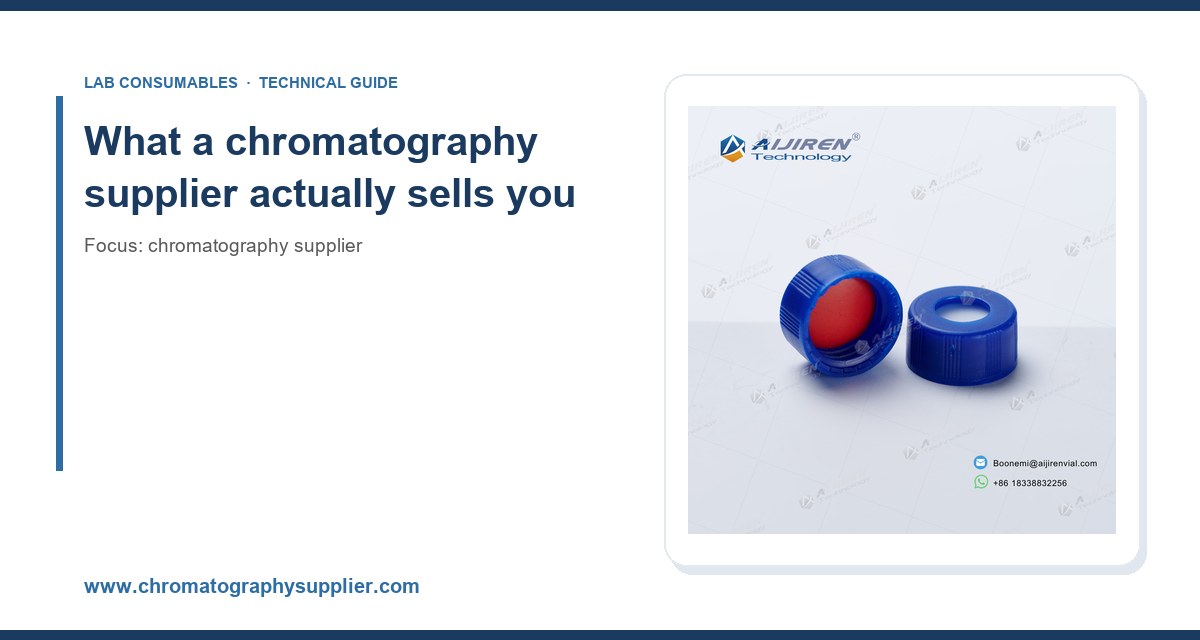
Vials are the highest-volume consumable and the one most likely to be bought purely on price. That is a mistake. A vial that is 0.3 mm out of tolerance will jam an autosampler carousel. A septum that is too soft will coring or shred, and those fragments end up in the needle. A closure that does not seal to the correct torque will evaporate your sample between prep and injection.
Specifications that matter
- Glass class: Type I borosilicate for most HPLC and GC work. Type 33 or Type II is acceptable for some applications but check extractables.
- Dimensions: 12 x 32 mm is the standard for 2 mL vials. 9 mm screw thread is the most common closure. 11 mm crimp and 20 mm crimp are the other two standards you will see.
- Septa: Silicone with PTFE facing is standard for HPLC. For GC-MS, use a higher-grade silicone with low bleed. Puncture count matters: a standard 1 mm silicone/PTFE septum is good for 1 to 3 punctures before it starts to leak or core. A pre-slit septum handles more, but only if the autosampler is set up for it.
- Closure torque: Screw caps should be tightened to 0.5 to 1.0 N·m. Over-torque deforms the septum and causes coring. Under-torque causes evaporation. A torque wrench or a calibrated capper is worth the $200.
- GPI thread standard: The Glass Packaging Institute thread finishes (GPI 9 mm, GPI 13 mm, GPI 18 mm) are the reference for screw thread compatibility. Ask your supplier which GPI finish their vial uses. If they cannot answer, they are not a glass specialist.
For closures specifically, I check the vial closures range against the autosampler manufacturer’s drawing before I approve a new lot. A 0.2 mm difference in cap height is enough to cause a needle crash on some Agilent and Waters autosamplers.
The extractables question
If you run LC-MS or GC-MS at low detection limits, ask for the extractables data on the septum and the vial glass. A supplier who cannot provide it is asking you to run the study yourself. That study costs $2,000 to $5,000 in lab time. Factor it into the price comparison.
Columns: qualification before commitment
Columns are the one category where I never buy on price alone. The qualification process is straightforward but takes discipline.
- Get the equivalence table. Ask for the phase, particle size, pore size, surface area, carbon load, endcapping, and pH range. Compare against your validated method’s column.
- Run a system suitability test. Use your existing method. Check theoretical plates (should be within 10% of the reference column), asymmetry (0.8 to 1.5), and retention time RSD (under 1% across 6 injections).
- Run a lifetime test. Inject a representative matrix 500 to 1,000 times and track back pressure and plate count. A column that loses more than 20% of its plate count in 500 injections is not equivalent, no matter what the catalog says.
- Compare lot-to-lot. Order two lots and run the same test. If retention times shift more than 2%, the manufacturing consistency is not there.
Agilent publishes detailed GC column and accessory specifications that are useful as a reference for what a proper spec sheet looks like. Thermo Fisher’s chromatography and sample handling documentation is similarly detailed for HPLC and UHPLC. Use these as the benchmark when a smaller supplier hands you a one-page datasheet.
Documents to demand before the first PO
This is the paperwork I require from any new supplier. It takes them a day to assemble and saves you a month of pain.
- Current ISO 9001 certificate with the certification body and expiry date.
- ISO 17034 accreditation if they sell reference materials.
- Sample CoA for the specific SKU you are buying, not a generic one.
- Dimensional drawing for vials and closures.
- Extractables or leachables summary for septa and vial glass.
- Material safety data sheets for solvents and standards.
- Change control policy in writing.
- Credit references from two labs of similar size.
- Lead time commitment for your top 10 SKUs.
If a supplier pushes back on any of these, that is your answer. The good ones send the package before you ask.
Regulatory and standards context
Procurement in a regulated lab is not just a commercial function. If you support environmental testing, your consumables need to be compatible with the methods you run. The U.S. EPA SW-846 test methods specify sample handling and preparation requirements that flow directly into vial and closure selection. Method 8260, for example, has specific requirements for volatile organics that affect headspace vial and septum choice. Get the consumable wrong and the method is out of compliance, not just out of specification.
For pharmaceutical work, USP <1058> and ICH Q2(R1) drive the analytical method validation requirements, and your supplier’s CoA needs to support the validation package. For food and feed, AOAC methods have their own consumable requirements. A supplier who understands which methods you run will flag compatibility issues before you order. That is worth more than a 3% discount.
If you outsource any of this work, the analytical testing partner you use should be working from the same consumable specifications you are. Mismatched vials between your lab and your contract lab is a classic source of failed round-robin comparisons.
Troubleshooting checklist: when a new supplier’s product underperforms
You will eventually get a bad lot. Here is the sequence I run before I call the supplier, because half the time the problem is on my side.
- Check the lot number. Compare against the CoA. If the lot does not match, you have a traceability problem.
- Run a system suitability test with a known-good reference. If the reference passes and the new lot fails, the problem is the consumable. If both fail, the problem is the instrument.
- Check the autosampler. Needle height, carousel alignment, and torque on the capper. A 0.5 mm needle height error will cause coring that looks like a septum defect.
- Check the septum. Look for coring, shredding, or a visible puncture larger than the needle. A 0.5 mm needle should leave a clean hole, not a tear.
- Check the vial dimensions. Measure OD and height with calipers on 10 vials from the lot. Compare to the drawing.
- Check the closure torque. Use a torque tester. Anything outside 0.5 to 1.0 N·m is a problem.
- Check the solvent and sample. A pH outside the column’s range will destroy a column faster than any manufacturing defect.
- Escalate with data. Send the supplier the lot number, the CoA, your test results, and the instrument log. A good supplier will replace the lot and investigate. A bad one will blame your method.
Restek maintains a deep technical resource library on chromatography troubleshooting that is worth bookmarking for the cases where the failure mode is not obvious. Their guides on peak shape, retention time drift, and septum bleed have saved me more than one service call.
Building a dual-source strategy
Single-sourcing is cheaper on paper and more expensive in practice. I run a primary/secondary split of roughly 70/30 by spend, with the secondary supplier qualified on the same checklist and kept active with quarterly small orders. The cost of keeping a secondary active is maybe 3 to 5% higher blended pricing. The cost of a single-source backorder during a method validation is a delayed product launch.
For vials and closures specifically, I keep two qualified suppliers on the approved vendor list at all times. For columns, I keep one primary brand and one qualified equivalent. For solvents, I keep two distributors who source from the same manufacturer, so the lot traceability is intact.
Takeaway
Price per unit is the last thing you should negotiate and the first thing most buyers lead with. Get the technical qualification, the documents, and the change control in place first. Then negotiate price against a supplier you already know can deliver. A 15% discount on a vial that cores your septum is not a saving, it is a deferred cost with interest. The chromatography supplier you keep should be the one that answers your method questions in under 24 hours and sends the CoA before you ask, not the one with the lowest number on the quote.
References & further reading
Related resources from our lab consumables network:
- Chromatography Supplier at chromatographysupplier.com
- Oem Vial at oemsamplevials.com
- Vial Closures at vialclosures.com
- Analytical Testing at labanalyticaltesting.com
External references and standards: