
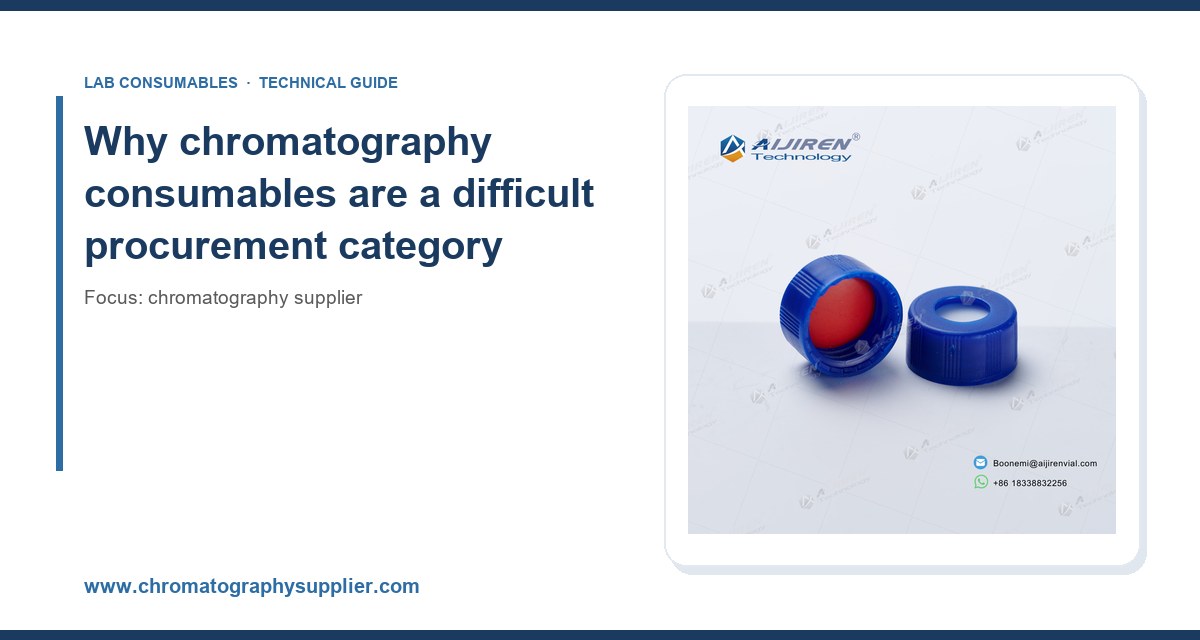
I have bought chromatography consumables from at least 40 suppliers over the past 15 years, and the single most expensive lesson I learned came from a vendor that quoted 18% below everyone else on 2 mL autosampler vials. The vials arrived with crimp necks that were 0.3 mm out of tolerance, and our autosampler gripper dropped roughly one vial in 60. We lost a week of sample throughput and had to re-run 240 injections. The savings on that purchase order were about $1,900. The cost of the failure was closer to $14,000 once I counted labor, instrument downtime, and the re-prep of standards. That is the real reason procurement on chromatography consumables deserves more attention than it usually gets.
This article covers what I actually look at when I evaluate a chromatography supplier: how pricing is structured, what MOQs really mean, and the specific technical criteria that separate a reliable vendor from a reseller with a good website. I will give you numbers you can put in a scorecard.
Chromatography consumables sit in an awkward spot. They are low unit cost but high consequence. A column, a vial, a septum, or a syringe filter costs a few dollars. If any of them fails, the analytical result is wrong, and the cost of a wrong result dwarfs the cost of the part by two or three orders of magnitude.
That asymmetry is why you cannot procure these items the way you procure gloves or pipette tips. The lowest bidder is not the right answer. You need a supplier who can hold dimensional tolerances, document material grades, and answer a technical question without transferring you to a sales rep who reads from a catalog.
The category also has more hidden variation than most buyers realize. Two vials that look identical can differ in glass hydrolytic class, neck geometry, and the flatness of the crimp sealing surface. Two C18 columns with the same particle size and dimensions can differ in endcapping, silanol activity, and lot-to-lot reproducibility. The spec sheet often does not tell you which one you are getting.
How chromatography consumable pricing actually works
Published list prices on chromatography consumables are almost meaningless. The spread between list and net for a routine order is typically 20% to 45%, and it depends on volume, contract terms, and whether you are buying direct from the manufacturer or through a distributor. Understanding the pricing layers helps you negotiate and helps you spot a quote that is too good to be true.
The three pricing tiers you will encounter
- Manufacturer list price. The anchor. For major brands like Agilent GC columns and accessories or Thermo Fisher chromatography and sample handling products, list is what you see in the catalog. Real transaction prices are lower.
- Distributor net price. Typically 10% to 30% below list, depending on your annual spend and the distributor’s agreement with the manufacturer. This is where most labs buy.
- OEM or private-label price. Often 15% to 40% below branded list for commodity items like vials, caps, septa, and filters. The trade-off is that you lose some brand-level documentation and the manufacturer relationship.
I have seen a single 2 mL clear glass vial with a PTFE/silicone septum and a crimp cap quoted at $0.42, $0.61, and $1.10 per unit by three different suppliers in the same week. All three met the basic dimensional spec. The differences were glass class, septum durometer, and whether the cap was pre-assembled with a verified seal.
What drives the price up or down
Four factors explain most of the price variation:
- Glass grade. USP Type I borosilicate is more expensive than Type II or Type III soda-lime. For HPLC and GC autosamplers, Type I is the default because it resists leaching and pH attack. If a quote is unusually low, ask what glass class is being supplied.
- Septa and closures. A basic silicone septum costs a fraction of a PTFE-faced, pre-slitted, low-bleed septum. The difference matters at trace levels. See vial closures for the closure types and what each is rated for.
- Tolerance and QC. Suppliers that measure neck ID, neck OD, and crimp height on every lot charge more. That measurement is what keeps your autosampler from dropping vials.
- Documentation. A certificate of analysis with actual measured values costs more than a generic COC. For regulated work under USP <621> or EPA methods, the documented version is worth the premium.
A realistic price benchmark
Here is a benchmark I use when a quote looks off. These are approximate 2024 to 2025 net prices for common items at moderate volume (10,000 to 50,000 units per year):
- 2 mL clear Type I autosampler vial, 11.6 x 32 mm, 8 mm crimp neck: $0.18 to $0.35 each
- 9 mm screw-thread vial, 11.6 x 32 mm, with PP cap and PTFE/silicone septum: $0.22 to $0.40 each
- PTFE/silicone septum, 9 mm, 0.9 to 1.0 mm thick: $0.05 to $0.12 each
- 0.22 µm PTFE syringe filter, 13 mm, 100/pack: $28 to $55 per pack
- Analytical HPLC column, 4.6 x 150 mm, 5 µm C18: $280 to $520 each
- GC capillary column, 30 m x 0.25 mm x 0.25 µm, 5% phenyl: $380 to $620 each
If a quote on the vial comes in at $0.09, something is wrong. Either the glass is not Type I, the septum is a cheaper durometer, or the dimensional tolerance is loose. Ask for the dimensional drawing and the glass class before you sign.
MOQ: what it really means and when it matters
Minimum order quantity is where a lot of procurement conversations go sideways. The number on the quote is rarely the number that matters. What matters is the effective cost per usable unit after you account for shelf life, storage, and the risk of a lot going bad before you use it.
The MOQ structures you will see
- Unit MOQ. A flat minimum, e.g., 1,000 vials or 100 filters. Simple but rigid.
- Case MOQ. Sold by the case (often 100, 500, or 1,000 units). This is the most common structure for vials and closures.
- Value MOQ. A minimum order value, e.g., $2,500 per PO. Common with distributors who carry multiple brands.
- Mixed-SKU MOQ. A total quantity threshold across multiple items. This is the most flexible and the one I prefer for labs that use a mix of vials, caps, and filters.
The shelf-life trap
Here is the calculation that most buyers skip. A box of 1,000 vials with a 5-year shelf life is fine at any reasonable order size. A pack of 100 syringe filters with a 2-year shelf life is not. If you order 12 packs to hit a value MOQ and use 3 packs a year, you will throw away 6 packs. That is a 50% waste rate on the item.
I use a simple rule: order no more than 12 months of usage for items with a shelf life under 3 years, and no more than 24 months for items with a shelf life over 3 years. Then negotiate the MOQ around that usage, not around the supplier’s case pack. Most suppliers will flex if you commit to a quarterly release schedule.
When a higher MOQ is actually the right call
There are cases where buying deep is smart. If you run a validated method on a specific column lot, buying a multi-year supply of the same lot locks in the retention time and avoids re-validation. I have done this with GC columns where a lot change would have forced a full method re-verification under EPA SW-846. A 24-month supply at a 15% volume discount beat a re-validation every time.
For commodity items like vials, caps, and filters, buy to usage. For method-critical items like columns and reference standards, buy to lot and document the lot number in your method file.
How to evaluate a chromatography supplier
I score suppliers on seven criteria. Each gets a weight, and the weighted score decides whether they stay on the approved list. Here is the scorecard I actually use.
1. Technical competence (weight 25%)
Can the supplier answer a technical question without escalating to a sales manager? I test this with a specific question during the evaluation: “What is the neck ID tolerance on your 11.6 mm crimp vial, and what glass hydrolytic class do you supply?” A competent supplier answers in the same email. A reseller forwards the question to the factory and gets back to you in three days with a generic spec sheet.
Ask also about the septum. A PTFE/silicone septum for HPLC should have a PTFE face on the sample side and a silicone backing. The PTFE thickness matters: 0.05 mm is thin and can coring under a needle; 0.13 mm is standard and resists coring. A supplier who knows this is a supplier worth keeping.
2. Dimensional and material documentation (weight 20%)
Request the actual dimensional drawing and the material certificate. For vials, I want to see:
- Neck OD and ID with tolerances (typically ±0.1 mm on a crimp neck)
- Body OD and height (11.6 ± 0.2 mm x 32 ± 0.5 mm for a standard 2 mL vial)
- Glass hydrolytic class (USP Type I or Type III)
- Crimp height and sealing surface flatness
For closures, I want the septum durometer (typically 45 to 55 Shore A for silicone), the PTFE thickness, and the cap material (polypropylene is standard; polyethylene is softer and can creep). The OEM vial suppliers who publish these numbers are a different class from the ones who do not.
3. Lot-to-lot consistency (weight 15%)
Ask for the last three certificates of analysis and compare the measured values. If the neck ID on lot A is 6.00 mm and on lot C is 6.08 mm, the process is drifting. A good supplier holds the neck ID within ±0.05 mm across lots. A supplier who cannot produce three COAs is a supplier you cannot qualify.
4. Traceability and documentation (weight 15%)
For regulated work, you need a certificate of analysis with actual measured values, not a certificate of conformance. You also need lot traceability from the raw glass and septum material through to the finished unit. Ask how long they retain lot records. Five years is the minimum for most pharma and environmental work. Ten years is better.
If you are running U.S. EPA SW-846 test methods for waste and materials, the documentation requirement is explicit. Method 8000 series and the associated determinative methods expect you to be able to demonstrate that your consumables did not introduce contamination. A supplier who cannot support that is a liability.
5. Lead time and stock position (weight 10%)
Ask for the current lead time on a specific SKU, not a generic “in stock” claim. For commodity vials and caps, a good distributor ships in 2 to 5 business days. For columns, 2 to 4 weeks is normal. If a supplier quotes 8 weeks on a standard 4.6 x 150 mm C18 column, they are drop-shipping and you have no visibility into the real lead time.
Also ask where the stock is held. A distributor with a domestic warehouse is worth a 5% price premium over one shipping from overseas, because the landed cost and the customs delay are real.
6. Quality system and corrective action (weight 10%)
Ask for their ISO 9001 certificate and, if they are a manufacturer, their ISO 13485 or equivalent. More importantly, ask for a redacted corrective action report from a recent quality escape. A supplier who can show you how they handled a bad lot is a supplier who has a real quality system. A supplier who says they have never had an escape is either lying or not tracking.
7. Commercial terms (weight 5%)
Payment terms, return policy, and freight. Net 30 is standard. Net 60 is negotiable at volume. For returns, I want a written policy that covers dimensional non-conformance and lot failure, not just “defective on arrival.” A vial that is out of tolerance is not defective on arrival in the usual sense, but it is unusable, and the supplier should take it back.
Decision checklist: scorecard with weights
Here is the full scorecard in a form you can copy into a spreadsheet. Score each criterion 1 to 5, multiply by the weight, and sum. A supplier scoring below 3.5 weighted is not approved.
- Technical competence (25%): answers dimensional and material questions without escalation
- Documentation (20%): provides drawing, material cert, and COA with measured values
- Lot consistency (15%): three COAs within ±0.05 mm on critical dimensions
- Traceability (15%): 5+ year lot records, raw material traceability
- Lead time (10%): 2 to 5 days on commodity, 2 to 4 weeks on columns
- Quality system (10%): ISO 9001, documented CAPA process
- Commercial terms (5%): net 30, written return policy for non-conformance
Operational precautions when you switch suppliers
Switching a consumable supplier is not a plug-and-play event. I have seen a lab switch vial suppliers and then spend three weeks chasing an autosampler gripper error that turned out to be a 0.2 mm neck OD difference. Here is what I do on every switch.
Qualification run before full adoption
Run a side-by-side qualification on at least 100 injections with the new consumable and the incumbent. Compare retention time RSD, peak area RSD, and any signs of carryover or ghost peaks. For vials, check for extractables by running a blank injection from a new vial and comparing to a blank from the incumbent. A difference in the 210 nm region is a red flag.
For septa, run a puncture test. A standard 9 mm PTFE/silicone septum should survive 3 to 5 punctures with a 22-gauge needle before coring becomes a risk. If you are running a 96-well plate with a multi-puncture method, you need a pre-slitted septum and you need to verify the slit orientation.
Torque and crimping parameters
If you are using crimp vials, the crimping force matters. A standard 8 mm crimp cap on an 11.6 mm vial should be crimped to a cap height of about 5.5 mm with a crimping force that seals the septum without cracking the neck. Too little force and you get evaporation; too much and you crack the glass. I use a crimper with a set stop and check the cap height with a caliper on the first 10 vials of every lot.
For screw-thread vials, the cap should be tightened to about 1.5 to 2.0 inch-pounds. Over-tightening deforms the septum and can cause coring. Under-tightening allows evaporation, which is a real problem for volatile analytes in a 24-hour autosampler run.
Storage and handling
Store vials and closures in the original packaging, away from UV and heat. Silicone septa absorb volatiles from the environment, so do not store them next to solvent bottles. I have seen a lab store septa in a cabinet with acetone and then wonder why their blanks showed acetone peaks. Keep the storage area below 30 °C and away from solvent vapors.
Troubleshooting checklist for supplier-related failures
When a chromatographic problem appears and you suspect the consumable, work through this list before you blame the instrument.
- Ghost peaks in the blank: run a blank with a new vial and a new septum. If the peak disappears, the consumable is the source. Common culprits are septum bleed (silicone at high inlet temperature) and vial extractables.
- Autosampler gripper errors: measure the neck OD on 20 vials with a caliper. If the spread exceeds 0.15 mm, the lot is out of tolerance. Check the crimp height on crimp vials.
- Retention time drift on a new column lot: run a system suitability standard and compare to the previous lot. A shift of more than 2% in retention time or 5% in tailing factor means the lot is different enough to require re-validation.
- Needle coring: inspect the septum after 5 punctures. Visible cores or a torn PTFE face means the septum is too thin or the needle is dull. Replace the needle and switch to a 0.13 mm PTFE-faced septum.
- Evaporation in long runs: weigh 10 vials before and after a 24-hour run. A loss of more than 2 mg per vial indicates a cap seal problem. Check torque and cap material.
- High background on a new filter lot: flush the filter with 5 mL of mobile phase and re-run the blank. If the background persists, the filter membrane is leaching. Switch to a different membrane chemistry (PTFE for aqueous, nylon for organic).
If you need independent confirmation of a failure mode, an analytical testing lab can run extractables and leachables on the suspect lot and give you a defensible report for the supplier claim.
Negotiation tactics that actually work
I have negotiated a lot of consumable contracts, and the tactics that move the needle are not the obvious ones.
Bundle across categories
A supplier who sells vials, caps, filters, and columns will flex more on the commodity items if you commit volume across the whole basket. I have gotten a 12% reduction on vials by moving the filter business to the same supplier. The margin on filters is higher, so the supplier can absorb the vial discount.
Commit to a release schedule, not a lump sum
A quarterly release schedule with a 12-month commitment gets you the volume price without the shelf-life risk. Suppliers like this because it smooths their production planning. I have used this to get case-pack pricing on orders that were below the case MOQ.
Ask for the lot reservation
For columns, ask the supplier to reserve a specific lot for your account. This is not always possible, but when it is, it eliminates the re-validation cost of a lot change. I have paid a 5% premium for a reserved lot and considered it cheap compared to a method re-validation.
Get the freight and duty in writing
The landed cost is what matters, not the unit price. A quote at $0.28 per vial with $400 freight and 6% duty is worse than a quote at $0.31 with free freight. Ask for the DDP price (delivered duty paid) so you can compare apples to apples.
A note on OEM and private-label sourcing
Private-label consumables are a legitimate option for commodity items, but the qualification burden is on you. The supplier may be the same factory that makes the branded product, or it may not. Ask for the factory name and the ISO certificate. If they will not disclose the factory, walk away.
The economics work best on vials, caps, septa, and filters. They work poorly on columns, where the stationary phase chemistry and the packing process are the product. I would not buy a private-label C18 column for a validated method. I would buy private-label vials all day, provided the dimensional and material documentation is there.
For buyers who want a single point of contact across the consumable range, a specialized chromatography supplier can consolidate the commodity items and reduce the number of POs and incoming inspections you have to manage. That consolidation has real value in a lab that runs 200 samples a day.
Reference standards and method documentation
One more thing that separates a good supplier from a great one: do they help you document the consumable in your method? A supplier who can provide the part number, lot number, and material specification in a format you can paste into a method file saves your QA team hours. For work under USP <621> or the EPA 8000 series, that documentation is not optional. The Restek technical resources are a good example of the level of documentation a serious supplier should be able to match.
Takeaway
Procurement of chromatography consumables is a technical qualification exercise, not a price comparison. Score suppliers on technical competence, documentation, lot consistency, and traceability before you look at the unit price. Benchmark your quotes against realistic net prices (roughly $0.18 to $0.35 for a 2 mL Type I vial, $280 to $520 for a 4.6 x 150 mm C18 column), and treat any quote more than 25% below that range as a signal to ask about glass class, septum durometer, and dimensional tolerance. Set MOQs around 12 months of usage for short-shelf-life items and buy to lot for method-critical items. Run a 100-injection qualification before you switch, check crimp height at 5.5 mm and screw torque at 1.5 to 2.0 inch-pounds, and keep the lot records for at least five years. The supplier who can answer a dimensional question in the first email is the one worth the 5% premium.
References & further reading
Related resources from our lab consumables network:
- Chromatography Supplier at chromatographysupplier.com
- Oem Vial at oemsamplevials.com
- Vial Closures at vialclosures.com
- Analytical Testing at labanalyticaltesting.com
External references and standards: