
I have spent the better part of fifteen years on the buying side of chromatography consumables, and I can tell you the single most expensive mistake I ever made was not a bad column. It was a bad supplier. We saved roughly 18% on a bulk order of 2 mL autosampler vials from a broker we had never audited. Six weeks later, three of our HPLC methods developed a phantom peak at 4.2 minutes that cost us two weeks of investigation, a failed analytical testing batch release, and a customer audit finding. The vials had been repackaged from an unknown source with a different silicone septum formulation. That is the lesson this guide is built around: the supplier is part of your method, whether your SOP acknowledges it or not.
What follows is how I actually evaluate chromatography suppliers now, from qualification through routine reorder, with the numbers and failure modes that matter.
Your HPLC or GC is a fixed variable. The column, the vial, the septum, the frit, the tubing, and the mobile phase salts are the moving parts, and every one of them is a supplier decision. A 2019-era autosampler running 96-well plates at 4°C will expose a low-grade septum to thousands of puncture cycles in a week. If the supplier swaps elastomer lots without telling you, you get coring, ghost peaks, and a needle that bends at the 12,000th injection. None of that shows up on a certificate of analysis unless you asked for the right tests.
I treat supplier selection as a method-validation activity, not a purchasing activity. That framing changes what you ask for and who signs off.
The six criteria I score every supplier against
I use a weighted scorecard. It is not glamorous, but it forces the conversation past price. Here is the version I currently run, with the weights I have settled on after too many near-misses.
1. Traceability and documentation (weight 25%)
Can the supplier tell you the lot number of the raw PTFE, the molding date of the septum, and the sterilization or cleaning batch? For regulated work under U.S. EPA SW-846 or USP <621>, you need a certificate of analysis that ties the finished vial or column to a manufacturing lot with a retained sample. Ask for a sample COA before you ask for a quote. If they cannot produce one within 48 hours, that tells you something.
2. Dimensional and material consistency (weight 20%)
This is where cheap suppliers fail first. A 2 mL vial should measure 12 x 32 mm with a 11 mm crimp or screw neck per the GPI 11 mm finish (the Glass Packaging Institute standard for that neck). The critical dimensions are the neck OD, the thread pitch on screw-thread vials, and the septa thickness. A septum that runs 0.5 mm thin will not seal reliably at 10 psi headspace pressure, and you will see it as a drifting retention time on your early-eluting peaks.
3. Column and consumable range (weight 15%)
A supplier who can cover your HPLC columns, your GC liners, your syringe filters, and your vial closures from one accountable source saves you audit time. But range without depth is a trap. I would rather have a supplier with three solid C18 chemistries and honest phase-collapse data than one with forty house-brand columns and no application support.
4. Lead time and stock reliability (weight 15%)
Ask for their last twelve months of on-time delivery data, not their target. For a routine 2 mL vial and cap, I expect 5 to 10 business days from a domestic distributor and no more than 4 weeks for a specialty column. Anything quoted at “6 to 8 weeks” for a standard C18 is a supply-chain warning sign.
5. Technical support depth (weight 15%)
Can the person on the phone read a chromatogram? I test this. I call and ask a specific question: “What is the maximum operating temperature for your PEEK-lined stainless tubing at 400 bar?” A good rep answers in under a minute. A bad one transfers you to a sales queue.
6. Price and total cost of ownership (weight 10%)
Price is last on purpose. A vial that costs $0.18 versus $0.24 is a rounding error next to a failed batch release. What matters is cost per injection, including rework.
Comparison checklist: what to demand in writing
Here is the table I actually fill in during qualification. Print it, send it to three suppliers, and compare the answers side by side.
- Vial neck finish: confirm GPI 11 mm for 2 mL, GPI 13 mm for 4 mL. Ask for a drawing, not a verbal confirmation.
- Septum specification: silicone/PTFE bonded, 1.0 mm nominal thickness for 11 mm, 0.010 in PTFE facing, durometer 45 to 55 Shore A.
- Puncture rating: minimum 1,000 punctures per septum for autosampler use at 22°C, with a stated failure mode (coring vs. compression set).
- Column pressure rating: 400 bar for standard HPLC, 1,000 bar for UHPLC, with a stated end-fitting torque of 1.0 to 1.5 N·m for 1/16 in fittings.
- Temperature range: GC septa rated to 350°C for high-temperature methods, with a bleed profile at 300°C.
- COA contents: lot number, raw material source, dimensional check, extractables screen (UV at 210 and 254 nm), and a retained sample reference.
- Lead time: committed number, not a range. Ask for the last quarter’s fill rate.
- Change control: written notice of any material or manufacturing change 90 days before shipment.
- Return and replacement policy: who pays freight on a failed lot, and how fast.
If a supplier cannot answer six of those nine in writing, I move on. The three I would accept partial answers on are lead time, price, and return policy.
Vials and closures: the details that bite you
This is where I have seen the most avoidable pain. The vial is a pressure vessel, a light path, and a chemical container all at once, and the closure is what makes it repeatable.
Glass and neck finish
For HPLC, Type I borosilicate glass at 1.0 mm wall thickness is the default. For GC headspace, you want a heavier wall (1.2 to 1.5 mm) and a crimp neck that holds pressure at up to 60 psi without deformation. The neck finish is not cosmetic. A GPI 11 mm screw thread with a 1.5 mm pitch will torque to 0.6 to 0.9 N·m and hold; a sloppy thread will cross-thread and leak. I have seen a whole plate of 96 vials leak because the caps were molded to a 0.2 mm undersize and the septa never compressed.
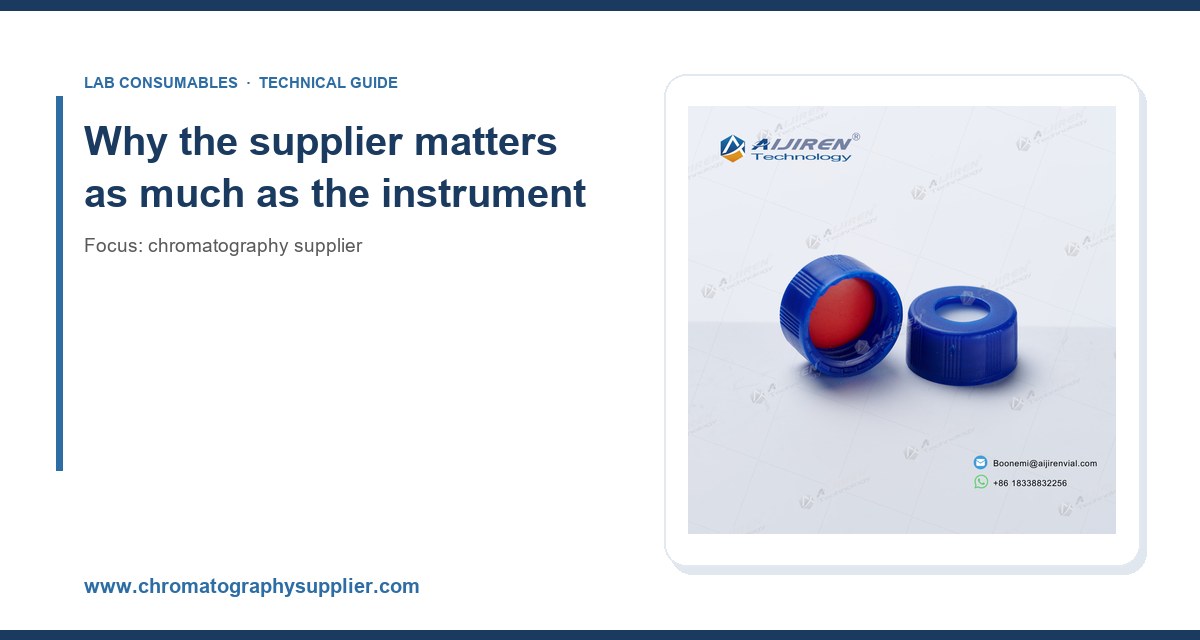
I source my vials through a specialist OEM vial channel and my closures through a dedicated vial closures supplier, because the two failure modes (glass dimensional drift and elastomer formulation drift) are managed by different people. When one supplier handles both, ask who their elastomer molder is and whether that molder has a change-control clause.
Septum chemistry
Silicone/PTFE is the workhorse. The PTFE facing is what contacts your sample; the silicone provides the reseal force. For volatile analytes in headspace, a butyl or bonded chlorobutyl septum gives lower gas permeability. For trace-level work in the low ppb range, I insist on a pre-cleaned, low-extractable septum and I verify it with a blank injection at 210 nm. If your supplier cannot give you an extractables profile, run one yourself before you trust a lot.
Puncture counts and the practical limit
Manufacturers quote 1,000 to 3,000 punctures. I plan for 500 for critical work and 1,000 for routine QC. The failure mode is not a clean hole; it is coring, where a plug of silicone drops into the vial and shows up as an extra peak or a blocked needle. If you see coring at 600 punctures, the durometer is too soft or the needle gauge is too large. A 22-gauge needle is the standard; going to 26-gauge for a small-volume method extends septum life but increases injection-to-injection RSD above 2% if the autosampler is not tuned for it.
Columns and consumables: what to ask beyond the datasheet
Column selection is its own discipline, but supplier selection for columns comes down to four questions I always ask.
- Is the phase lot-traceable? Ask for the retention factor (k’) and selectivity data for a reference mix on the actual lot you will receive. A C18 with a k’ of 4.2 on toluene versus 5.8 on the next lot is a method transfer problem.
- What is the actual pressure limit? A column rated at 400 bar should be tested at 350 bar for a sustained run without a pressure spike. Ask for the backpressure at 1.0 mL/min on a 4.6 x 150 mm, 5 µm column: expect 80 to 120 bar with a 60:40 methanol/water mobile phase.
- What is the end-fitting torque? Over-torquing a 1/16 in fitting to 2.0 N·m crushes the ferrule and creates a dead volume that shows up as peak tailing. The spec is 1.0 to 1.5 N·m. Ask if the supplier supplies a torque wrench with the column.
- What is the shelf life and storage condition? A C18 stored in 100% acetonitrile at 4°C is fine for 24 months; one stored dry will take longer to equilibrate and may show a retention drift of 5 to 8% in the first 20 injections.
For GC, the equivalent questions are about liner deactivation, septum bleed at temperature, and the maximum continuous operating temperature of the column. A 5% phenyl column rated to 325°C is not the same as one rated to 350°C for a 30-minute hold. Ask for the bleed chromatogram at the top of the range.
I keep current technical references from the major vendors on hand when I write a spec, because their published data is often the most defensible source in an audit. The Agilent chromatography consumables and columns library and the Thermo Fisher chromatography and sample handling resources are two I check first. For method development and troubleshooting, Restek technical resources has some of the clearest guidance on bleed and liner selection I have found.
Operational precautions before you sign a contract
Qualification is not a one-time event. Here is what I do before a first production order and again at every annual review.
Run a lot-to-lot comparison
Order three lots of the same vial and septum. Run a blank injection and a mid-level standard on each. Compare retention time RSD (target <1%), peak area RSD (target <2%), and a visual coring check after 200 punctures. If any lot drifts more than 3% from the others, reject it and ask why.
Audit the change-control clause
This is the clause that saves you. It must say the supplier will notify you in writing of any change to raw material source, molding process, or sterilization method at least 90 days before the change ships. I have seen a supplier switch septum silicone suppliers and not tell anyone; the result was a 0.3 mm dimensional shift and a month of ghost peaks.
Check the storage and shipping conditions
Vials ship in bags, not always in cleanroom packaging. Ask whether the vials are double-bagged, whether the septa are shipped in a sealed foil pouch, and whether the shipment is temperature-controlled. A pallet of vials that sat in a 40°C warehouse for a week will have a compressed septum that never reseals properly. I have rejected a shipment for exactly this.
Verify the certificate of analysis against the lot
Do not trust a generic COA. The lot number on the COA must match the lot on the carton, and the dimensional data must be from that lot. I keep a log of every COA I receive and spot-check one lot per quarter against a physical measurement with calipers.
Troubleshooting checklist: when the supplier is the suspect
When a method goes bad and the instrument checks out, work this list in order. I have used it more times than I care to admit.
- Ghost peaks at a consistent retention time: suspect septum extractables or vial leachables. Run a blank with a new lot and a known-good lot side by side.
- Retention time drift on early peaks: suspect septum compression set or a leaking cap. Check torque at 0.6 to 0.9 N·m and inspect for a 0.2 mm gap at the neck.
- Needle coring or blocked needle: suspect septum durometer (too soft) or needle gauge (too large). Switch to a 22-gauge needle and a 50 Shore A septum.
- Peak tailing that appears after a column change: suspect over-torqued fittings. Re-torque to 1.0 to 1.5 N·m and check for a crushed ferrule.
- High background at 210 nm: suspect mobile phase salts or vial glass. Run a water blank through a new lot.
- Pressure spike at the top of a gradient: suspect column frit or a partially clogged inlet. Check backpressure against the 80 to 120 bar baseline for a 4.6 x 150 mm, 5 µm column.
- Lot-to-lot area RSD above 3%: suspect the supplier’s raw material. Request the raw material COA and compare.
When two or three of these stack up on the same lot, stop troubleshooting the instrument and call the supplier. The fastest resolution I have had was a supplier who overnighted a replacement lot and a prepaid return label within four hours of my email. That is the behavior you are buying.
My recommendation
If you are setting up a supplier panel from scratch, here is what I would do, with the numbers I would put in the contract.
- Primary supplier: a full-line distributor with a documented 95% on-time fill rate over the last four quarters, a 48-hour COA turnaround, and a written 90-day change-control clause. Use them for columns, liners, and routine consumables.
- Secondary supplier: a specialist vial and closure house with a GPI 11 mm drawing on file, a stated septum durometer of 45 to 55 Shore A, and a 1,000-puncture minimum rating. Keep them qualified even if you buy elsewhere, because a single-source vial is a single point of failure.
- Tertiary supplier: a broker or OEM channel for price benchmarking only. Never let a broker be your only source for a critical consumable. Use the Chromatography Supplier directory to find and compare qualified houses in your region before you commit.
Set a reorder trigger at 30% of stock for routine vials and one full column for each validated method. Re-qualify the panel every 12 months with the lot-to-lot comparison above. And put the change-control clause in writing, because the supplier who will not sign it is the supplier who will surprise you.
The cheapest vial is never the cheapest vial. The supplier who can prove traceability, hold a dimension to 0.1 mm, and tell you about a material change before it ships is the one who keeps your method validated and your audits clean. Buy the documentation, not the discount.
References & further reading
Related resources from our lab consumables network:
- Chromatography Supplier at chromatographysupplier.com
- Oem Vial at oemsamplevials.com
- Vial Closures at vialclosures.com
- Analytical Testing at labanalyticaltesting.com
External references and standards: