
I have spent the better part of fifteen years on the buying side of chromatography consumables, and the single most expensive mistake I ever made was not a bad column or a contaminated mobile phase. It was a supplier who could not tell me, on a Friday afternoon, which lot number of septa had gone into the shipment that was already on a truck. That one gap cost us three days of rework and a 340-injection batch we had to throw out. Supplier selection is a technical decision, not a procurement formality, and it deserves the same rigor you apply to method validation.
This guide is the document I wish someone had handed me in year one. It covers how to evaluate a chromatography supplier against your actual workflow, the specs that matter, the failure modes that show up six months after the purchase order, and a decision framework you can score on paper. I will be opinionated. You should be too.
People say “supplier” and picture a catalog. In practice you are buying four things at once, and they fail independently:
- Consumables with finite lives: columns, guard cartridges, vials, caps, septa, syringe filters, inlet liners.
- Reference materials and standards: certified solutions, calibration mixes, matrix spikes.
- Documentation: certificates of analysis, lot traceability, USP <621> or ISO 17025 conformity statements, safety data sheets.
- Logistics and technical support: lead time, cold-chain integrity, application help when a peak splits.
A supplier who is excellent at two of these and weak at the other two is a liability. I have seen vendors with flawless product quality and a support line that routes you to a generalist who has never seen a chromatogram. I have also seen the reverse: a sharp applications chemist backed by a warehouse that ships the wrong phase two times in five.
It helps to put a number on each of the four. On consumables, the failure that hurts most is not the occasional defective part; it is the drift in quality between lots that you only notice when a sequence of 200 injections starts showing a tailing factor creeping from 1.1 to 1.6. On documentation, the number that matters is the time to produce a lot-tied CoA during an audit, and anything over five minutes of digging tells you the quality system is manual. On logistics, the number is the on-time delivery rate over a rolling twelve months, and I want to see it above 95% before I trust a lead time. On support, it is the time to reach a chemist who can read a chromatogram, and same day is the only acceptable answer.
The selection criteria that actually move the needle
1. Lot traceability and certificate quality
Ask for the certificate of analysis before you place the first order, not after. A usable CoA for a column lists the stationary phase, particle size, pore size, dimensions, USP designation (for example L1 for C18, L11 for phenyl, L7 for C8), and a test chromatogram with retention and efficiency values. For vials and closures, you want dimensional tolerances and the resin or elastomer grade, not a generic “borosilicate glass” line.
I score this hard. If a supplier cannot produce a CoA with a lot number that ties to the physical box in under five minutes, that is a red flag. In a regulated lab, an auditor will ask for exactly that link, and “we will email it” is not an answer you want to give under observation. Suppliers who also run their own analytical testing and publish method-level data tend to be the ones who understand why the paperwork matters.
There is a second layer to this that catches people: the CoA has to match the method you are running. A column released against a generic test mix tells you the bed is packed, not that it will separate your critical pair. I ask for the release chromatogram and compare the selectivity of the two closest peaks against my own system suitability injection. If the supplier’s release test uses a different mobile phase and a different temperature, the numbers are a sanity check at best. I have rejected a lot where the release efficiency was 92,000 plates per meter and my own test gave 61,000 on the same phase, because the difference told me the packing batch was not what the certificate implied.
2. Dimensional and material specs you can verify
Vials are where sloppy suppliers get exposed. A standard 2 mL autosampler vial is 12 x 32 mm with a 6 mm opening, and it should conform to the widely used 32 x 11.6 mm dimensional convention that autosampler trays are built around. Deviations of half a millimeter cause gripper faults on a robotic sampler, and you will not discover it until the run is underway.
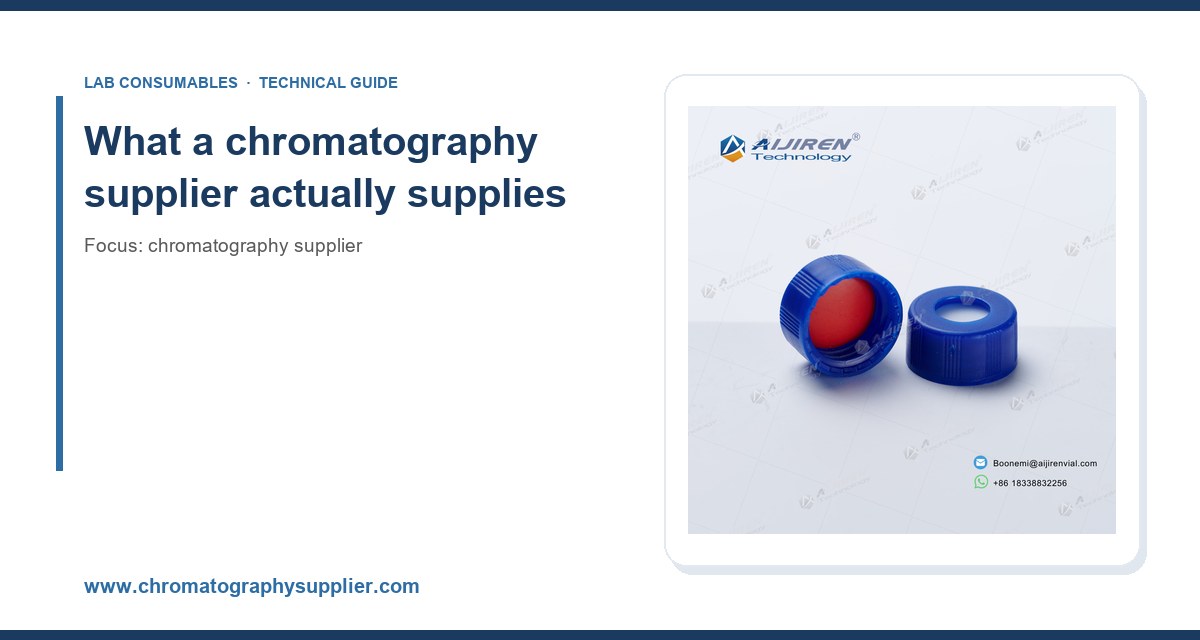
For closures, ask about the septa. A silicone/PTFE-lined septum for a 9 mm screw cap is typically 1 mm thick, and the PTFE facing is what protects your sample from the silicone. Puncture counts matter: a good silicone septum tolerates roughly 50 to 100 punctures on a screw cap before coring becomes a risk, and a pre-slit septum trades that for easier needle entry at the cost of evaporation. If you are running overnight sequences, specify pre-slit and accept the trade. If your analytes are volatile, do not.
I buy closures from vendors who will state the durometer and the compression set of the elastomer. A septum that takes a permanent set after one autosampler pass leaks, and a leaking vial in a headspace run shows up as a ghost peak you will chase for a week. Good sources for these parts include dedicated vial closures specialists and OEM vial manufacturers who publish the drawings.
The dimension that bites hardest is the neck finish. A crimp vial uses an 11 mm aluminum seal with a specific crimp geometry, and a screw-thread vial uses a 9 mm thread with a molded finish that has to seat against the cap liner. Mixing the two, or buying a crimp seal from a supplier whose die is 0.2 mm off, gives you a seal that passes a visual check and fails a leak test. I keep a go/no-go gauge on the bench and check the first five vials from every case. It costs nothing and it has caught two off-spec batches in five years.
3. Column and phase consistency
For HPLC, the number to demand is lot-to-lot retention reproducibility. A reputable supplier will quote a relative standard deviation on retention time, and I want to see RSD below 2% across lots for the same method. For GC columns, the equivalent is film thickness tolerance and bleed specification at the upper temperature limit. If a supplier cannot tell you the maximum operating temperature of a capillary column and the bleed at that temperature, keep looking.
This is where the big houses earn their keep. Agilent chromatography consumables and columns and Thermo Fisher chromatography and sample handling publish detailed technical data sheets, and their application notes are a genuine resource when you are transferring a method. Restek technical resources for chromatography are another strong reference, particularly for GC method development and phase selection.
Two more numbers I want from any column supplier. First, the particle size distribution: a 5 µm C18 should have a tight distribution, and a supplier who cannot state the d10 and d90 is guessing. Second, the end-capping chemistry and the silanol activity, because that is what determines whether your basic analytes tail. For a method with a pKa-sensitive compound, ask for the silanol activity test result and the lot’s tailing factor for a basic probe. If the answer is “it passes USP,” that is not enough; USP <621> sets a floor, not a promise.
4. Lead time and stock depth
Ask for the actual lead time on a specific part number, in writing, twice. Then ask what happens when the primary warehouse is out. A supplier who can ship a guard cartridge in 24 hours but takes three weeks on the analytical column has not solved your problem. I keep a two-supplier strategy for anything on the critical path, and I benchmark the second supplier quarterly so the relationship stays warm.
The number I track is days of cover on the bench. For a column that runs 150 injections a week, I want at least two spares on the shelf, which is roughly four to six weeks of cover. For septa and caps, I want a case of each, because a single case of 100 caps lasts a busy lab about a month. When a supplier quotes a 10-day lead time and I only have 14 days of cover, that is a supply risk, not a price question.
5. Technical support depth
Call the support line with a real problem before you commit. Ask a specific question: “My peak is fronting at 1.2 minutes on a C18 with a 0.1% formic acid mobile phase, what is your first move?” A good applications chemist will ask about injection volume, sample solvent strength, and column temperature in that order. A bad one will read you a troubleshooting script. The difference is worth real money when a method is failing at 2 a.m.
I also test the support line on a documentation question, because a chemist who cannot find a CoA is not going to find a method transfer note either. Ask for the application note for a specific compound class on a specific phase. If they have one, read it and check whether the method conditions are realistic. If they do not, ask when it was last updated. A supplier whose application library is five years stale is telling you where their investment goes.
Comparison checklist with concrete numbers
Here is the scorecard I use. Weight the criteria to your workflow, but do not skip any row. A supplier that scores below the floor on any single line is disqualified regardless of total.
- CoA availability: on request within 5 minutes, tied to lot number. Floor: must exist.
- Vial dimension conformance: 12 x 32 mm body, 6 mm neck, within 0.3 mm. Floor: within 0.5 mm.
- Septum puncture rating: stated, at least 50 punctures for screw cap. Floor: stated at all.
- Retention RSD across lots: below 2% for HPLC. Floor: below 3%.
- GC column max temperature: stated with bleed data. Floor: stated.
- Lead time: quoted in writing, 48 hours for stocked items. Floor: 5 business days.
- Cold-chain for standards: validated shipper with temperature logger. Floor: gel packs and documented pack-out.
- Support response: applications chemist reachable same day. Floor: next business day.
- Regulatory documentation: ISO 17025 or USP <621> conformity statements available. Floor: available on request.
I have walked away from suppliers who could not clear the septum and dimension rows even though their column pricing was 15% lower. The 15% never covered the rework.
Score each row 1 to 5 and multiply by a weight. For a regulated QC lab, documentation and traceability carry the most weight, maybe 30% between them. For a method development group, column consistency and support depth matter more, and lead time can drop to 10%. The point of the exercise is not the total; it is the floor. A supplier who scores a 2 on CoA availability is out, no matter how good the price is.
Operational precautions once you have chosen
Qualify every lot, not just the first
Run a system suitability test on each new lot of columns and each new case of vials. For a C18 column that means injecting a standard mix and checking tailing factor (target below 2.0), theoretical plates, and retention time against the previous lot. For vials, I run a simple dye test: fill ten vials from a new case, cap them, and check for leaks after a 24-hour hold at 4 °C. It takes twenty minutes and has caught two bad cases in five years.
The qualification should be written down, with acceptance criteria, because the value is in the comparison to the previous lot, not the absolute number. I keep a spreadsheet with the last ten lots of each column: retention time of the main peak, tailing factor, plate count, and the date. When a new lot lands, the numbers go in the same row and I look at the trend, not just the pass/fail. A lot that passes USP but sits at the edge of the historical spread is a warning, and I will hold it for non-critical work rather than release it to a validated method.
Control the septum torque
Screw caps are not “hand tight and hope.” A magnetic cap tool or a torque-limited capper set to roughly 0.5 to 0.8 N·m gives consistent sealing without crushing the septum. Over-torqued caps core the needle and shed silicone into the vial, and that shows up as a late-eluting ghost. Under-torqued caps evaporate. If you are running a 96-well plate overnight, this is the difference between a clean run and a re-injection.
I learned the torque number the hard way. A technician who was capping by feel was averaging well above the upper limit, and the coring showed up as a silicone fragment in about one vial in fifty. The fragment did not always interfere, which made it worse, because it hid in the baseline until a run where the fragment happened to elute near a target peak. A torque screwdriver at 0.6 N·m fixed it. The cost was forty dollars and a ten-minute training.
Watch the inlet liner and the filter
Inlet liners are consumables with a service life. A deactivated glass wool liner in a split/splitless inlet typically needs changing every 100 to 200 injections depending on matrix. A syringe filter with a 0.22 µm PTFE membrane is fine for most organic mobile phases but will adsorb proteins and some basic analytes; for those, use a regenerated cellulose membrane. Match the membrane to the chemistry, and do not assume “0.22 µm” means interchangeable.
Two more numbers for the filter. A 13 mm filter with a 0.22 µm membrane holds about 100 µL of sample in the housing, which matters when you only have 200 µL to begin with. And the burst pressure on a good syringe filter is well above the 100 psi a manual syringe generates, so if you are blowing a filter, the problem is the sample, not the filter. I standardize on one membrane chemistry per method and write it into the procedure, because swapping membranes mid-method is a silent source of recovery loss.
Respect the standards
Certified reference solutions degrade. Store them per the CoA, check the expiry on receipt, and re-certify or discard on schedule. For environmental work, follow the method documentation in U.S. EPA SW-846 test methods for waste and materials; the holding times and preservation requirements are not suggestions. A supplier who ships a standard without a temperature logger on a July delivery is telling you something about their quality system.
The cold-chain number I insist on is a logger with a readable history, not a gel pack and a promise. If the shipment arrives above 8 °C for more than two hours, I reject it, because the concentration of a volatile standard can drift several percent and you will not see it until the calibration curve bends. That rejection has happened twice in fifteen years, and both times the supplier replaced the shipment without argument, which is exactly the behavior you want to see from a qualified vendor.
Troubleshooting checklist for supplier-related failures
When a run goes bad, work through this list before you blame the method. In my experience, roughly half of “method failures” trace back to a consumable or a supplier lot.
- Ghost peaks late in the run: suspect septum coring or a contaminated liner. Change both, then re-run.
- Retention time drift across a sequence: suspect mobile phase evaporation, a leaking vial cap, or a column at end of life. Check torque and cap integrity first.
- Peak fronting that appears suddenly: suspect a new column lot or a partially clogged frit. Compare against the previous lot’s test chromatogram.
- Loss of response for volatile analytes: suspect pre-slit septa or loose caps. Switch to non-slit and re-torque.
- Baseline noise on GC: suspect column bleed above the rated temperature or a contaminated carrier gas line. Verify the column’s max temperature and the trap condition.
- Autosampler gripper faults: suspect out-of-tolerance vial dimensions. Measure ten vials from the case with calipers.
- Standard concentration off by more than 5%: suspect cold-chain failure or an expired reference. Pull the shipment temperature log.
If two or more of these appear in the same week and you have not changed your method, the common variable is usually a recent lot. That is when you call the supplier with the lot number in hand and ask for the release data.
Build a two-supplier strategy, then audit it
The single biggest structural improvement I made was moving from one primary supplier to a qualified primary and a qualified secondary for every critical part number. The secondary gets a small but steady share of the volume, enough to keep the account active and the lead time honest. I re-score both against the checklist every six months and rotate the primary if the secondary beats it on two consecutive audits.
The share I give the secondary is deliberate: about 15% of volume on columns and 25% on vials and caps. That is enough to keep the account open and the pricing current, but not so much that a failure at the secondary disrupts a validated method. When the secondary wins the audit twice, they get the primary share for the next six months, and the old primary drops to 15%. This keeps both honest and gives me a tested fallback when a truck is late.
For a broader view of what the market offers, start with a specialist chromatography supplier and compare their published specs against the checklist above. Ask for the CoA, the dimensional drawing, and the retention RSD before you talk price. The suppliers who answer those three questions well are the ones who will still be answering the phone when a batch fails at midnight.
Takeaway
Choose a chromatography supplier the way you would qualify a method: define the acceptance criteria, demand the data, and verify on every lot. The specs that matter are concrete (12 x 32 mm vials, 6 mm necks, 1 mm septa rated for 50-plus punctures, retention RSD under 2%, stated GC maximum temperatures, written lead times, and lot-tied CoAs), and a supplier who cannot meet them on paper will not meet them in the warehouse. Score candidates on the checklist, keep a qualified secondary for every critical part, and re-audit twice a year. The cost of a bad supplier is never the price difference; it is the rework, the re-injection, and the batch you cannot release.
References & further reading
Related resources from our lab consumables network:
- Chromatography Supplier at chromatographysupplier.com
- Oem Vial at oemsamplevials.com
- Vial Closures at vialclosures.com
- Analytical Testing at labanalyticaltesting.com
External references and standards: