
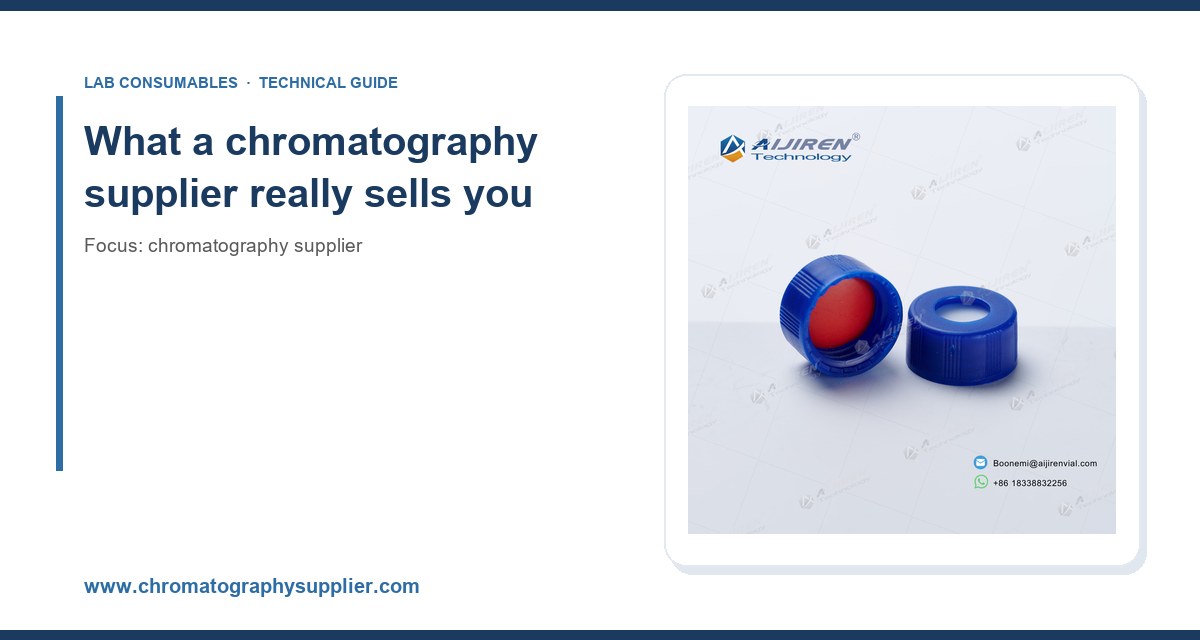
I still remember the first time I bought septa on price alone. The quote was 18% below my incumbent, the MOQ was one case, and the sales rep promised “identical to Agilent.” Twelve injections into a 96-sample pesticide panel, I had ghost peaks at every retention window and a baseline drift that made integration impossible. The septa were bleeding phthalates because they had been molded from recycled silicone with no post-cure. That purchase saved us $340 and cost us two days of instrument time plus a re-run on 88 samples. I have not bought a chromatography consumable on unit price since.
This article is what I wish someone had handed me in 2009. It covers how chromatography supplier pricing actually works, what MOQs tell you about a supplier’s real capability, and the specific checks I run before putting a new vendor on our approved list. It is written for procurement managers and lab managers who need to defend a PO, not just place one.
A chromatography supplier is not a catalog. The good ones are a supply chain with a technical layer bolted on. When you buy a case of 2 mL autosampler vials, you are buying glass draw tolerance, dimensional consistency at the neck, and a certificate of analysis that will survive an audit. When you buy a GC column, you are buying a manufacturing batch with a test chromatogram you can compare against your own. The price difference between a $38 case of vials and a $92 case of vials is almost never the glass. It is the QC behind the glass.
I separate suppliers into three tiers, and the tier determines how I negotiate:
- Tier 1: OEM and primary manufacturers. They make the glass, mold the caps, or coat the stationary phase. Agilent, Restek, Thermo Fisher, Waters, and a handful of Asian glass plants fall here. Pricing is list-minus, MOQs are case-level, and lead times are predictable but not always short.
- Tier 2: Value-added distributors and private-label houses. They buy from Tier 1 plants, relabel, and add kitting, lot traceability, and technical support. This is where most of the market lives. Margins are 20 to 45 points, which is why negotiation works here.
- Tier 3: Brokers and importers. Lowest price, thinnest documentation, highest variability. Useful for non-critical glassware and general lab plastics. Dangerous for anything that touches the flow path.
If your supplier cannot tell you which tier they sit in, that is your first red flag. A serious vendor will name their glass plant or their column manufacturing site without hesitation.
How chromatography consumable pricing is actually structured
List price is a fiction. Every chromatography supplier runs a price book with a discount matrix that depends on annual spend, contract length, payment terms, and how much of your catalog you consolidate with them. Here is the structure I have seen repeatedly across distributors:
The discount stack
A typical Tier 2 distributor quote for a $10,000 annual account looks like this on paper: 25% off list for the base agreement, another 5% for a 12-month committed volume, another 3% for net-30 payment, and 2% for electronic ordering through punchout. That is 35% off list, which sounds generous until you realize the list price was set 40 points above landed cost. The real negotiation is not the discount percentage. It is the price floor on high-volume SKUs.
I negotiate two numbers separately:
- Blanket discount on the long tail (glassware, filters, syringes, tubing). 20 to 30% off list is normal for a mid-size lab.
- Fixed unit price on the top 20 SKUs by spend. These are the vials, caps, septa, and inlet liners that move every week. Lock these at a hard number, not a percentage, and lock them for 12 months with a stated cap on annual increase (I accept 3 to 5%, no more).
What drives the unit price of a vial
Take a 2 mL clear glass autosampler vial, 12 x 32 mm, 9 mm screw thread, GPI 9-425 neck finish. Landed cost from a Chinese glass plant in 2024 runs roughly $0.035 to $0.055 per vial in 100-vial trays at 50,000-unit volumes. A US-molded equivalent lands at $0.09 to $0.14. The delta is glass draw consistency (USP Type I borosilicate with tight ID tolerance), dimensional sorting, and lot-level dimensional QC. If a quote comes in at $0.02 per vial, ask what the neck ID tolerance is. If the answer is “standard,” walk away. Standard means ±0.5 mm, and that will cause autosampler gripper failures and septa push-through.
Septa are the same story. A 9 mm silicone/PTFE septa at 45 Shore A runs $0.04 to $0.09 each in bulk. The cheap ones are 50 Shore A with no post-cure, and they will bleed. The good ones are post-cured and pre-slit if you are running a headspace or splitless method. A pre-slit septa costs about 30% more and is worth every cent if your method has a 1-minute hold at 250 °C inlet temperature.
Column pricing
GC and HPLC columns are the highest-margin item in the catalog and the least negotiable. A 30 m x 0.25 mm x 0.25 µm 5% phenyl column from a Tier 1 manufacturer lists around $450 to $550. Distributor cost is typically 55 to 65% of list. You can negotiate 15 to 25% off list on columns if you commit to a category, but you will not get 40%. Column manufacturing is capital-intensive and the batch test data is the product. If a supplier offers 45% off a branded column, ask whether it is a genuine part or a “compatible” that will fail your system suitability test.
For reference on what a real column datasheet should contain, the technical libraries at Restek and Agilent are the benchmarks I hold new suppliers to. If your vendor’s spec sheet is thinner than those, you are buying a commodity, not a column.
MOQ: what it tells you, and how to negotiate it
Minimum order quantity is a diagnostic, not just a constraint. A supplier with a 10-case MOQ on vials is either a broker reselling from someone else’s inventory or a manufacturer with a small run size. A supplier with a 1-case MOQ on vials and a 5-case MOQ on custom caps is probably a distributor with decent stock depth. A supplier with a 50,000-piece MOQ on a custom-labeled vial is a real manufacturer running a dedicated mold, and that MOQ is a genuine setup cost, not a sales tactic.
MOQ benchmarks by category
- Standard 2 mL vials and 9 mm caps: 1 to 10 cases (100 to 1,000 units) from distributors; 20,000 to 50,000 units from manufacturers for custom colors or liners.
- Septa: 100 to 500 pieces from distributors; 10,000 to 25,000 from molders.
- Inlet liners: 5 to 25 pieces from distributors; 500 to 2,000 from glass shops for custom deactivation.
- GC columns: 1 each, always. If a supplier has a column MOQ above 1, they are sourcing on demand and you will wait 6 weeks.
- HPLC tubing and fittings: 10 to 50 pieces per size from distributors; 500+ from manufacturers.
How to break an MOQ
Three tactics work. First, consolidate across product families. If you commit to vials, caps, septa, and liners from one supplier, the aggregate order value often clears their MOQ threshold even if each line is below it. Second, accept a stock color or liner instead of a custom one. The MOQ on a custom cap color is often 50,000 units; the same cap in standard white is 1 case. Third, agree to a scheduled release. A 12-month blanket with quarterly releases of 5,000 units each often gets you manufacturer pricing without holding 20,000 units in your stockroom.
What you should not do is accept a sub-MOQ order at a premium and assume it will scale. I have seen labs pay 40% over list for a 2-case order and then discover the supplier cannot deliver 20 cases on a 3-week lead time because they were drop-shipping all along.
Vial and closure specifications that separate suppliers
This is where procurement decisions get made or unmade. The vial is a precision component, and the spec sheet is where you find out whether your supplier knows that.
Glass and dimensional tolerances
Demand USP Type I borosilicate glass for anything going into an autosampler. Type I has a hydrolytic resistance that meets USP <660> and will not leach sodium into your sample. The critical dimensions:
- Body OD: 12.00 ± 0.20 mm for a 2 mL vial. Anything outside that will jam in a 12-position autosampler carousel.
- Height: 32.00 ± 0.30 mm. Off-height vials cause needle-height errors and partial injections.
- Neck ID: 6.00 ± 0.20 mm for a 9 mm screw thread. This is the tolerance that most cheap vials fail.
- Neck finish: GPI 9-425 thread. The Glass Packaging Institute standard is what makes a cap from one supplier fit a vial from another. If your supplier cannot cite the GPI thread designation, assume it is proprietary.
For a deeper spec breakdown on OEM-grade vials, the reference material at OEM Vial is a useful benchmark. I use it to cross-check dimensional callouts before I approve a new lot.
Caps, septa, and torque
The closure is where most sample integrity failures happen. A 9 mm screw cap with a silicone/PTFE septa is the default, but the details matter:
- Septa hardness: 45 Shore A for standard, 50 Shore A for high-temperature. Softer septa seal better but coring is worse.
- Puncture count: A good silicone/PTFE septa survives 3 to 5 punctures before coring becomes a risk. Pre-slit septa are single-use for headspace. Do not push past 5 injections on a single septa in a splitless method at 250 °C; you will see ghost peaks from the coring.
- Torque: Hand-tight plus a quarter turn is roughly 1.5 to 2.0 in-lb. Over-torquing (above 3 in-lb) deforms the septa and causes needle bending. Under-torquing causes evaporation loss on a 24-hour autosampler run. I keep a torque screwdriver on the bench and check every new cap lot at 1.8 in-lb.
- Cap material: Polypropylene is standard. Polyethylene caps are cheaper but creep under torque and lose seal over 12 hours.
If you are sourcing caps separately from vials, the closure specialists at Vial Closures publish the GPI and thread compatibility tables that let you mix and match without a fit test. That is worth bookmarking before your next bid round.
How to evaluate a chromatography supplier: a scored checklist
I score every new supplier on 100 points across seven categories. Anything below 75 does not get a PO. Here is the checklist with the weights I use and the concrete pass criteria.
1. Documentation and traceability (20 points)
- Certificate of analysis per lot with dimensional data, not just a pass/fail stamp (8 points).
- Glass type declaration (USP Type I, Type II, or Type III) with a hydrolytic resistance test reference (6 points).
- Material safety data sheets and REACH/RoHS declarations on file (3 points).
- Lot number traceable to manufacturing date and plant (3 points).
2. Dimensional and functional QC (20 points)
Ask for the last 10 lot CoAs and check the spread on neck ID and height. If the supplier cannot produce 10 lots of data, they are not running lot-level QC. A pass here means the neck ID standard deviation is under 0.05 mm across lots. I also ask for a puncture test result (coring count) and a leak test at 1.5 psig for 60 seconds.
3. Lead time and stock depth (15 points)
- Standard SKUs ship in 3 to 5 business days from a domestic warehouse (8 points).
- Custom or non-stock items quoted at 4 to 6 weeks with a written commitment (4 points).
- Emergency drop-ship capability for a line-down situation (3 points).
4. Pricing transparency (15 points)
A good supplier gives you a price book with SKU-level unit prices, not a “call for quote.” Pass criteria: at least 80% of your top 20 SKUs are on a published or quoted fixed price with a 12-month validity. If a supplier will not put a number on paper, they are planning a mid-year increase.
5. Technical support (10 points)
Can you reach an applications chemist, not just a sales rep? I test this by asking a real method question during the evaluation (e.g., “what septa do you recommend for a 1-minute hold at 280 °C inlet?”). A Tier 1 or good Tier 2 supplier answers in a day. A broker forwards your email to the manufacturer and you hear back in a week.
6. Quality system and audit history (10 points)
ISO 9001 is the floor. ISO 13485 if you are in a regulated pharma or clinical environment. Ask for the last audit date and any open corrective actions. A supplier who cannot produce an ISO certificate within 24 hours is not certified.
7. Commercial terms (10 points)
- Net-30 or better (4 points).
- Free freight above a stated threshold (3 points).
- Return policy on defective lots with no restocking fee (3 points).
Score each category, multiply by the weight, and you get a number. I have run this on 14 suppliers in the last five years. The three that scored above 85 are still on our list. The four that scored below 70 are gone, and two of them were the cheapest quotes in their bid round.
Supplier evaluation in practice: a worked comparison
Here is a real comparison from a 2023 bid round for 2 mL vials, 9 mm caps, and septa at an annual volume of 60,000 vials.
- Supplier A (Tier 1 OEM): $0.12/vial, $0.07/cap, $0.08/septa. MOQ 10 cases. Lead time 3 days. CoA per lot with dimensional data. ISO 9001. Score 91. Annual spend $16,200.
- Supplier B (Tier 2 distributor): $0.08/vial, $0.05/cap, $0.05/septa. MOQ 5 cases. Lead time 5 days. CoA per lot, dimensional data on request. ISO 9001. Score 82. Annual spend $10,800.
- Supplier C (Tier 3 importer): $0.045/vial, $0.03/cap, $0.03/septa. MOQ 1 case. Lead time 14 days. CoA is a pass/fail stamp, no dimensional data. No ISO certificate produced. Score 58. Annual spend $6,300.
Supplier C is $9,900 cheaper per year on paper. It is also the supplier that will cost you a $4,000 instrument service call and a 200-sample re-run when the neck ID tolerance drifts. I have made that trade and lost. We went with Supplier B and kept Supplier A as the secondary for critical methods. The $5,400 premium over Supplier C bought us lot-level QC and a 5-day lead time, which is the cheapest insurance in the lab.
Operational precautions when switching suppliers
A supplier change is a method change until you prove otherwise. Run these steps before you release a new lot into production:
- System suitability test on the new vials and septa against your current lot. Run 10 injections of a mid-level standard and compare peak area RSD. Acceptable is <2.0% RSD for the new lot and a difference of <3% in mean area versus the old lot.
- Septa bleed test: run a blank gradient or temperature program with the new septa at your method’s maximum inlet temperature. Any ghost peak above 0.5% of your smallest calibrator is a fail.
- Autosampler fit test: run a full 96-vial tray with the new vials and watch for gripper errors. More than 2 errors in 96 is a fail on dimensional tolerance.
- Torque check: measure 10 caps at 1.8 in-lb with a torque screwdriver. Any cap that backs off below 1.2 in-lb after 24 hours is a seal risk.
- Retain samples: keep 10 vials from each new lot for 12 months. If a customer complaint comes in, you need the lot.
For regulated work, the method validation reference is U.S. EPA SW-846 for environmental methods and USP <621> for chromatographic system suitability. Both specify the acceptance criteria you should hold a new consumable lot to. If you outsource any of this, the contract lab at Analytical Testing can run the comparison panels independently, which is useful when a supplier disputes your fail result.
Troubleshooting checklist: when a new supplier lot fails
When a lot goes bad, work through this in order. I have diagnosed every consumable failure I have seen with these six steps.
- Ghost peaks or baseline drift: septa bleed. Check inlet temperature against septa rating. Replace with a post-cured, pre-slit septa and re-run the blank.
- Peak area RSD above 2%: vial neck ID out of tolerance causing needle seal issues, or cap torque inconsistent. Measure 10 vials with calipers and 10 caps with a torque driver.
- Autosampler gripper errors: vial OD or height out of spec. Check against 12.00 ± 0.20 mm and 32.00 ± 0.30 mm.
- Sample evaporation over a 24-hour run: cap creep or under-torque. Re-torque to 1.8 in-lb and re-weigh 10 vials before and after.
- Coring and needle blockage: septa hardness too low or puncture count exceeded. Switch to 50 Shore A and cap at 3 punctures per septa.
- Column failure within 100 injections: check the inlet liner and the vial cap liner. A phthalate bleed from a cheap cap will trash a column faster than anything else in the flow path.
For method-specific troubleshooting on columns and inlet systems, the technical notes at Thermo Fisher chromatography and sample handling are a solid starting point. I keep their inlet liner selection guides pinned above my bench.
Consolidation versus multi-sourcing: a decision rule
Every procurement manager faces the same question: one supplier for everything, or three suppliers for resilience? My rule is simple. Consolidate 80% of spend with one primary supplier and keep 20% with a qualified secondary. The primary gets you the volume discount and the fixed pricing. The secondary keeps the primary honest and covers you when a lot fails or a shipment is delayed.
The exception is columns. Never single-source columns. A column is a method-critical component, and you want at least two manufacturers qualified for every method you run. The cost of a second qualification run (typically 20 to 40 injections) is trivial compared to a 6-week lead time on a sole-sourced column.
For a full catalog view of what is available across the supplier tiers, the directory at Chromatography Supplier is a reasonable starting point for building a bid list. I use it to identify Tier 2 candidates before I send out an RFQ.
Takeaway
Chromatography supplier procurement is a technical exercise, not a purchasing one. Price the vial by its dimensional tolerance and its CoA, not its unit cost. Treat MOQ as a signal of manufacturing depth, not a barrier. Score every new supplier on documentation, QC data, lead time, and technical support before you place a PO. The cheapest quote in the room is almost always the most expensive line item in your annual budget once you count instrument downtime, re-runs, and the method revalidation you will do when the lot fails. Lock your top 20 SKUs at fixed unit prices for 12 months, hold your suppliers to GPI 9-425 and USP Type I glass, and keep a second qualified source for every column in your method list.
References & further reading
Related resources from our lab consumables network:
- Chromatography Supplier at chromatographysupplier.com
- Oem Vial at oemsamplevials.com
- Vial Closures at vialclosures.com
- Analytical Testing at labanalyticaltesting.com
External references and standards: